



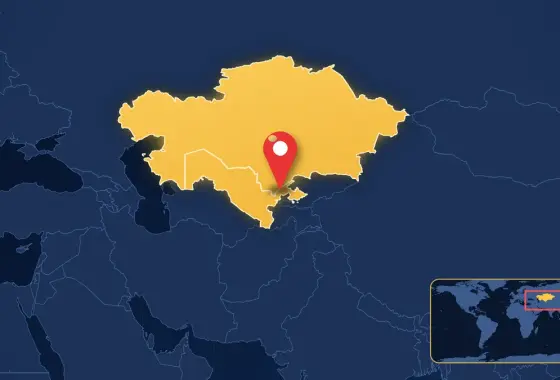
What happened at the border crossing?
Uzbekistan and Kazakhstan have reopened one of Central Asia’s busiest border crossings following nearly two years of reconstruction work. The Gishtkuprik checkpoint near Tashkent on the Uzbek side and the Zhibek Zholy checkpoint in Kazakhstan’s Saryagash district on the Kazakh side officially resumed service on 25 November.
Uzbekistan’s Customs Committee press secretary Husen Tangriyev said passenger traffic resumed from 16:00 on 25 November. The reconstruction work had originally been expected to take four months, but technical and logistical issues stretched it out to nearly two years. The Kazakh-side name “Zhibek Zholy” means “Silk Road” in Kazakh, a nod to the route’s historical links to the ancient trade roads connecting Central Asia with Europe and China.
How much has the new capacity grown?
The upgraded checkpoint is designed to handle 70,000 travellers a day under normal conditions, rising to 100,000 during peak periods. Before its closure, the crossing recorded more than 11 million passenger crossings in 2024, equivalent to an average of around 30,000 people a day.
On the Uzbek side, the facility’s area has been expanded from 6 to 9 hectares. The number of pedestrian lanes has risen from 4 to 8, vehicle inspection lanes from 4 to 18, and parking capacity from 20 to 200 vehicles. On the Kazakh side, two new passenger terminals covering roughly 10,000 square metres in total have been built, featuring 82 passport control booths and 20 automated passport control gates.
The upgraded crossing is designed to accommodate up to 3,000 passenger cars and 400 buses a day, marking a significant capacity increase not just for pedestrians but for vehicle crossings as well.
What has changed in the technological infrastructure?
Iroda Isoqova, a senior inspector at Uzbekistan’s Customs Committee, told Euronews that advanced inspection technologies had been introduced, including X-ray scanners, body scanners, radiation detection systems and modern surveillance equipment.
“One of the key innovations is the Smart Customs Border system, which will help streamline customs procedures, reduce waiting times and improve the overall passenger experience,” Isoqova said. The digital system is intended to make crossings faster and more predictable for travellers.
Why were wait times so long before?
Asqarjon Mahmudov, deputy chairman of the Uzbek Cultural Association in Kazakhstan’s Saryagash district, told Euronews: “Previously, when crossing by car, we would wait three or four hours, sometimes even 12 hours. There were times when we spent the entire night waiting.”
While the checkpoint was closed, passenger vehicles were diverted to the neighbouring Navoi checkpoint, which was originally built for freight traffic; truck access there was temporarily restricted during that period. According to Uzbekistan’s Customs Committee, Gishtkuprik’s reopening will allow freight traffic to resume through Navoi, easing pressure on other crossings along the border.
What will the impact be on tourism and trade?
Uzbekistan recorded more than 11.6 million foreign visitor arrivals for tourism purposes in the first ten months of 2026, up 19.4% compared with the same period last year. Kazakhstan was the second-largest source of visitors with more than 2.7 million arrivals; visitor numbers from Germany and the United Kingdom each rose by 26%, while arrivals from France increased by 20%.
For international travellers, the reopened checkpoint restores a direct road connection between Tashkent and Shymkent, a major city in southern Kazakhstan. According to Uzbekistan’s state news agency UzA, bilateral trade between the two countries reached $4.4 billion in the first ten months of 2026. Uzbek officials stress that much of the growth in tourism revenue depends on visitors arriving by road from neighbouring countries, so shorter waits at border crossings translate directly into higher tourism income.
Are other border crossings in the region also being upgraded?
Gishtkuprik-Zhibek Zholy is not an isolated case; the two countries have been modernising multiple checkpoints along their shared border in recent years. In June 2026, Kazakhstan’s Senate ratified a protocol granting the Syrdarya-Malik and Seliny-Akaltyn road checkpoints international status and round-the-clock operation, aimed at distributing truck and passenger traffic more evenly along the border.
Under Kazakhstan’s customs infrastructure plans, a broader reconstruction programme aims to raise the country’s overall daily passenger capacity at border crossings from around 28,000 to 112,000. The reopening of Gishtkuprik-Zhibek Zholy stands out as one of the most visible examples of that wider modernisation effort.
What does this mean in practice for border residents?
For tens of thousands of people living in the area between Tashkent and Shymkent, with family, work or education ties on both sides of the border, the reopening directly affects daily life. Long, roundabout crossings previously made via Navoi can now be completed more quickly directly through Gishtkuprik-Zhibek Zholy.
Shorter waiting times also matter for local businesses and small traders who make a living from cross-border commerce; in previous years, some traders had to wait overnight in queues to keep perishable goods from spoiling. Officials expect such delays to be significantly reduced with the new digital system in place. According to local news sources, residents in the area welcomed the reopening as a long-awaited relief for family visits and weekend shopping trips across the border.
How does this connect to the EU’s Middle Corridor plan?
The reopening comes at a time when Central Asia’s two largest economies are strengthening their trade and tourism ties, and the European Union is seeking more efficient transport connections with the region. On 16 November, representatives from the EU, Central Asia, the South Caucasus and the Black Sea region met in Brussels to advance cooperation on transport, energy and digital infrastructure.
One of the European Commission’s key priorities is developing the Middle Corridor, connecting Central Asia to European markets via the Caspian Sea and the South Caucasus. The Commission aims to triple trade flows along this route by 2030 and significantly cut freight transit times; the modernisation of the Gishtkuprik-Zhibek Zholy crossing, while serving passenger traffic, indirectly contributes to that broader regional connectivity goal. Officials attending the Brussels meeting stressed that boosting passenger and freight capacity along the Middle Corridor would ease the region’s access to European markets and reduce dependence on routes running through Russia.
What does this mean?
The reopening of the Gishtkuprik-Zhibek Zholy checkpoint is a practical development that will directly affect everyday life and regional trade between Uzbekistan and Kazakhstan. Hours-long waits are expected to give way to a faster, technology-assisted crossing process, which could help sustain growth in tourism and trade between the two countries. This assessment rests on the official figures released; how smoothly the new capacity performs in practice will become clear over time. In the coming months, changes in both passenger numbers and bilateral trade figures will be the most concrete measures of the modernisation’s real impact. How quickly freight traffic normalises at the neighbouring Navoi checkpoint is another detail worth watching.
This report was compiled as of 28 November 2026, 09:00 Türkiye time; figures and details may differ between sources and may be updated as events develop.
Frequently asked questions
When did the border crossing reopen?
On 25 November 2026, with passenger traffic resuming from 16:00; the reconstruction had taken nearly two years.
How large is the daily capacity?
Up to 70,000 travellers a day under normal conditions, rising to 100,000 during peak periods.
Can trucks use this crossing?
No; it serves pedestrians, cars and buses, while truck traffic continues through the neighbouring Navoi checkpoint.
What other crossings between the two countries are being modernised?
In June 2026, Kazakhstan’s Senate ratified a protocol granting the Syrdarya-Malik and Seliny-Akaltyn checkpoints international status and round-the-clock operation, part of a wider regional upgrade programme.
Sources and further reading
- Euronews (Dilbar Primova), “Uzbekistan and Kazakhstan reopen key border crossing for up to 100,000 travellers a day”, 27 November 2026.
- tr.euronews.com, “Uzbekistan and Kazakhstan open Gishtkuprik-Zhibek Zholy: 100,000 passengers a day” (Turkish edition), 27 November 2026.
- Spot.uz, “Gishtkuprik checkpoint on Kazakhstan border to reopen on November 25”, 23 November 2026.
Cite this article
Use this article as a source in your work, assignment or blog:
YulaHub Editorial Team. (28 November 2026). Uzbekistan-Kazakhstan Border Crossing Reopens After 2 Years: 100,000 Passengers a Day. YulaHub. https://yulahub.com/en/uzbekistan-kazakhstan-border-crossing-reopens-after-2-years-100000-passengers-a-day
YulaHub Editorial Team. "Uzbekistan-Kazakhstan Border Crossing Reopens After 2 Years: 100,000 Passengers a Day." YulaHub, 28 November 2026, https://yulahub.com/en/uzbekistan-kazakhstan-border-crossing-reopens-after-2-years-100000-passengers-a-day.
<a href="https://yulahub.com/en/uzbekistan-kazakhstan-border-crossing-reopens-after-2-years-100000-passengers-a-day">Uzbekistan-Kazakhstan Border Crossing Reopens After 2 Years: 100,000 Passengers a Day</a> (YulaHub)
Leave a comment
Your email address will not be published. Required fields are marked *