



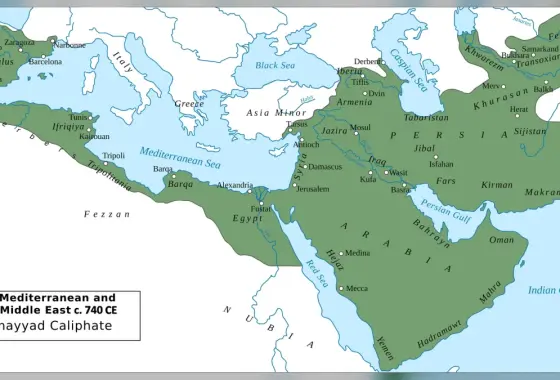
The Umayyads were the Islamic dynasty that began with the caliphate of Mu’awiya ibn Abi Sufyan after Ali’s death in 661 and lasted about ninety years. With Damascus as their capital, the Umayyads turned the caliphate from an elective office into a hereditary monarchy. In this period the Islamic state reached its greatest extent and acquired a true imperial administration.
The great conquests
- North Africa and al-Andalus: After the conquest of the Maghreb, an army led by Tariq ibn Ziyad crossed the Strait of Gibraltar in 711; much of the Iberian Peninsula soon became part of the Islamic world. The name Gibraltar (Jabal Tariq, "Tariq’s Mountain") still recalls him.
- Transoxiana: Qutayba ibn Muslim advanced into Central Asia, including Bukhara and Samarkand. This region later became an important bridge through which the Turks encountered Islam.
- Sind: Under Muhammad ibn al-Qasim, the Indus basin was reached.
In the west, the advance was halted at the Battle of Tours (Poitiers) in France in 732.
Building the state
Under the caliph Abd al-Malik ibn Marwan (685–705), state records were translated from Greek and Persian into Arabic, and the first Islamic gold and silver coins were minted. The postal service was developed. The Dome of the Rock in Jerusalem, completed in 691–692, is regarded as the oldest surviving masterpiece of Islamic architecture. The Great Mosque of Damascus, built under al-Walid I, is famous for its mosaics.
The tragedy of Karbala
The killing in 680 of Husayn, the Prophet’s grandson, and members of his family at Karbala by the army of Yazid is one of the most painful events in Islamic history. It left a deep wound in the memory of all Muslims and became a central remembrance commemorated during the month of Muharram, especially in the Shia tradition.
Umar ibn Abd al-Aziz: a symbol of justice
Discrimination and heavy taxes imposed on non-Arab Muslims (mawali) under the Umayyads caused great discontent. In his short reign, the caliph Umar ibn Abd al-Aziz (717–720) sought to remedy these injustices, abolished unjust taxes on new converts and ordered the compilation of hadith. Because of his justice and simple life he is called the "fifth rightly guided caliph". His approach rested on the Qur’an’s emphasis on the equality of people:
يَا أَيُّهَا النَّاسُ إِنَّا خَلَقْنَاكُم مِّن ذَكَرٍ وَأُنثَىٰ وَجَعَلْنَاكُمْ شُعُوبًا وَقَبَائِلَ لِتَعَارَفُوا ۚ إِنَّ أَكْرَمَكُمْ عِندَ اللَّهِ أَتْقَاكُمْ ۚ إِنَّ اللَّهَ عَلِيمٌ خَبِيرٌ ﴿١٣﴾“O people! We created you from a male and a female and made you into nations and tribes so that you may know one another. The most honoured of you in the sight of God is the most God-conscious of you. God is All-Knowing, All-Aware.”
The end of the dynasty and its continuation in al-Andalus
The discontent of the mawali, tribal rivalries and anger at injustices done to the Prophet’s family strengthened the Abbasid movement that began in Khorasan. With the Battle of the Zab in 750, the Umayyad dynasty fell. Abd al-Rahman I, an Umayyad prince who escaped the massacre, crossed to al-Andalus and in 756 founded the Umayyad state centred on Córdoba, which became one of the most brilliant cultural centres of Europe.
Mu‘awiya and Damascus as capital
The founder of the Umayyad state, Mu‘awiya ibn Abi Sufyan, had been governor of Syria since the time of Umar. On becoming caliph in 661 he moved the capital from Medina to Damascus. He employed local Syrian officials familiar with Byzantine administrative traditions, and built a regular army and navy. His naming of his son Yazid as heir, however, turned the caliphate from an office filled by choice into dynastic rule — a decision long debated in Islamic history.
Abd al-Malik’s reforms: Arabic and Islamic coinage
Caliph Abd al-Malik ibn Marwan (685–705) reorganised the state thoroughly. Government registers previously kept in Greek and Persian were converted to Arabic, making Arabic the empire’s official language. In 696–697 the first fully Islamic gold dinars and silver dirhams were struck, bearing no images but only Qur’anic verses and religious phrases. These coins are also an early example of writing taking centre stage in Islamic art.
Architecture: from the Dome of the Rock to the desert palaces
The Dome of the Rock (691–692), built by Abd al-Malik in Jerusalem, is the oldest surviving major Islamic building; with its octagonal plan, golden dome and mosaics it still stands today. The Umayyad Mosque of Damascus (705–715), built by his son al-Walid I, became a model for many later mosques with its vast courtyard and magnificent mosaics. Umayyad princes also built palaces in the deserts of Jordan and Syria for hunting and retreat; Qusayr Amra, famous for its wall paintings, is on the UNESCO World Heritage List.
The question of the mawali
With the conquests, millions of people in Iran, Iraq, Egypt and Central Asia became Muslim. Under Umayyad rule, however, these non-Arab Muslims (mawali) were at times treated differently from Arabs in taxation and military pay. This situation, at odds with Islam’s principle of equality, created widespread discontent. The reforms of Umar ibn Abd al-Aziz tried to remedy the injustice, but the problem was never fully solved and became one of the main causes of the Abbasid revolution.
The beginnings of cultural and scholarly life
The Umayyad era is when the foundations of the Islamic sciences were laid. In Basra and Kufa the rules of the Arabic language were studied systematically for the first time, and dots and vowel marks were added to letters to ensure the correct reading of the Qur’an. The first official steps encouraging the writing down of hadith were taken under Umar ibn Abd al-Aziz. Hasan al-Basri (d. 728), with his sayings on asceticism and ethics, is counted among the forerunners of the later Sufi tradition. Around the court, poets such as Jarir, al-Farazdaq and al-Akhtal produced unforgettable works of Arabic literature in their poetic duels.
Frequently asked questions
Where does the name "Umayyad" come from?
The dynasty belonged to the Banu Umayya clan of the Quraysh tribe; the name comes from this ancestor.
Are the Dome of the Rock and al-Aqsa Mosque the same building?
No. Both stand on the Haram al-Sharif in Jerusalem; the octagonal building with the golden dome is the Dome of the Rock, and the large mosque to the south is al-Aqsa Mosque.
Sources and further reading
- Türkiye Diyanet Vakfı İslâm Ansiklopedisi, “Emevîler”, “Ömer b. Abdülazîz”, “Kubbetüssahre”.
- al-Tabari, The History of al-Tabari.
- Hugh Kennedy, The Prophet and the Age of the Caliphates.
- Encyclopaedia Britannica, “Umayyad dynasty”.
People also ask
What was the Umayyad Caliphate? The Umayyad Caliphate was founded in 661 by Mu‘awiya ibn Abi Sufyan, with its capital at Damascus.
When was the Umayyad Caliphate founded? Founded: 661, Mu‘awiya ibn Abi Sufyan.
What was the Umayyad Caliphate’s capital? Capital: Damascus.
When did the Umayyad Caliphate reach its greatest extent? Greatest extent: From Spain to the Indus valley.




Leave a comment
Your email address will not be published. Required fields are marked *