




Muhammad (peace be upon him) is the prophet Muslims believe to be God’s final messenger, to whom the Qur’an was revealed. The discipline that studies his life, words and practice is called sira. For Muslims he is a model not only as the bearer of the faith but also as a husband, father, neighbour, teacher and statesman.
Birth and early life
According to tradition, Muhammad was born in Mecca in 571, the year known in the sources as the "Year of the Elephant", into the Banu Hashim clan of the Quraysh tribe. His father Abdullah died before he was born, and his mother Amina when he was six. He was raised first by his grandfather Abd al-Muttalib and then by his uncle Abu Talib. In his youth he earned his living as a shepherd and a merchant; because of his honesty and reliability the people of Mecca called him "al-Amin" (the trustworthy).
At 25 he married Khadija, a respected and wealthy woman whose trading business he managed. Khadija was his greatest supporter during the hardest times of his life.
Prophethood and the Meccan period (610–622)
At 40, Muhammad received the first revelation in the Cave of Hira. Among the first believers were his wife Khadija, his cousin Ali, his close friend Abu Bakr and his freed slave Zayd ibn Haritha. After three years of private preaching, he began to proclaim Islam openly. At the heart of his message were the oneness of God, the equality of people, care for the poor and the orphan, and accountability in the hereafter.
- Persecution: Mecca’s leaders saw the new faith as a threat to the established order. Muslims without protection, and enslaved Muslims in particular, suffered harsh persecution.
- Emigration to Abyssinia (615): To protect them, the Prophet sent a group of Muslims to the land of the Negus, a Christian king known for his justice. The Negus took them under his protection; the event is remembered as one of the earliest shining examples of respect between faiths in Islamic history.
- The boycott and the Year of Sorrow: The Banu Hashim endured an economic and social boycott lasting about three years. Shortly after it ended, in 619, Khadija and Abu Talib died; that year is remembered as the "Year of Sorrow".
- The Night Journey and Ascension: According to Islamic belief, one night the Prophet was taken from the Sacred Mosque in Mecca to al-Aqsa Mosque, and from there to the heavens. The five daily prayers were made obligatory with this event.
The Hijra and the Medinan period (622–632)
After the Muslims of Medina pledged their allegiance at Aqaba, Muslims began emigrating to Medina. In 622 the Prophet himself emigrated to Medina with Abu Bakr. The event was considered so significant that under Umar it was adopted as the starting point of the Islamic (Hijri) calendar.
- The Prophet’s Mosque: Built after his arrival in Medina, it was a centre of education, consultation and social welfare as well as worship.
- Brotherhood (mu’akhat): The emigrants from Mecca (Muhajirun) and the people of Medina who welcomed them (Ansar) were declared brothers; the Ansar shared their homes and livelihoods with the emigrants.
- The Constitution of Medina: A written agreement was drawn up setting out the rights and duties of the Muslims, the Jewish tribes of Medina and the city’s other inhabitants. Historians regard it as an early constitutional text governing the coexistence of different communities.
- War and peace: The battles of Badr (624), Uhud (625) and the Trench (627) were the major struggles with Mecca. The Treaty of Hudaybiyya of 628, though it seemed unfavourable to the Muslims at first, allowed Islam to spread rapidly in a time of peace.
- The conquest of Mecca (630): The Prophet entered Mecca almost without bloodshed and declared a general amnesty for the Meccans who had opposed him for years. This amnesty is remembered as one of history’s most striking examples of mercy and forgiveness.
The Farewell Pilgrimage and his death
In 632 the Prophet performed the Farewell Pilgrimage, his only pilgrimage after the Hijra, and addressed tens of thousands of Muslims. In these sermons he stressed the sanctity of life, property and honour, the rights of women and the equality of human beings:
يَا أَيُّهَا النَّاسُ، أَلَا إِنَّ رَبَّكُمْ وَاحِدٌ، وَإِنَّ أَبَاكُمْ وَاحِدٌ، أَلَا لَا فَضْلَ لِعَرَبِيٍّ عَلَى أَعْجَمِيٍّ، وَلَا لِعَجَمِيٍّ عَلَى عَرَبِيٍّ، وَلَا لِأَحْمَرَ عَلَى أَسْوَدَ، وَلَا أَسْوَدَ عَلَى أَحْمَرَ، إِلَّا بِالتَّقْوَى“O people! Your Lord is one and your father is one. An Arab has no superiority over a non-Arab, nor a non-Arab over an Arab; nor does a red-skinned person have superiority over a black person, nor a black person over a red-skinned person, except through piety.”
A few months after the Farewell Pilgrimage, in 632, Muhammad died in Medina at the age of 63 and was buried in his room next to the Prophet’s Mosque. Today his grave lies beneath the green dome of the Prophet’s Mosque.
Character and conduct
The sources describe him as a man who lived simply, did his own chores, showed tenderness to children and the elderly, valued consultation and treated even his enemies justly. The Qur’an describes him as follows:
وَمَا أَرْسَلْنَاكَ إِلَّا رَحْمَةً لِّلْعَالَمِينَ ﴿١٠٧﴾“We have not sent you (O Muhammad) except as a mercy to the worlds.”
Legacy
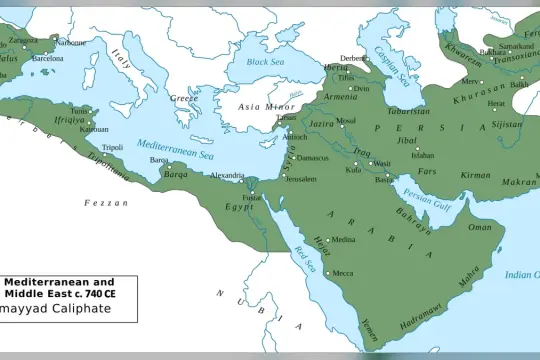
By the time of Muhammad’s death, the Arabian Peninsula, once made up of warring tribes, had been united under a single faith and community. His sayings and practice (sunna) were compiled in collections of hadith and became the second fundamental source of Islam after the Qur’an. In the centuries that followed, Islamic civilisation experienced a brilliant age of science, art and thought across a vast area stretching from Spain to Central Asia.
The Constitution of Medina
Shortly after his migration to Medina, the Prophet drew up a written agreement regulating relations among the Emigrants, the Helpers (Ansar) and the Jewish tribes living in the city. Known as the “Constitution” or “Charter of Medina”, the document defines the parties’ shared duty of defence, the way disputes are to be resolved and the right of the Jews to practise their own religion. The text is preserved in Ibn Ishaq’s biography of the Prophet. Many researchers regard it as an early example of a “constitution” defining different faith communities within a shared political order.
Hudaybiyya: a victory brought by peace
In 628 the Prophet set out with his Companions for Mecca to perform the lesser pilgrimage, but the Meccans refused to let them in. The treaty signed after negotiations at Hudaybiyya at first seemed to contain terms unfavourable to the Muslims, and some Companions were disappointed. Yet the ten-year peace allowed Islam to spread rapidly in Arabia. The Qur’anic chapter al-Fath, revealed after the treaty, describes the event as “a clear victory”. Two years later Mecca was conquered almost without bloodshed.
Frequently asked questions
Are pictures of the Prophet Muhammad made in Islam?
In the Islamic tradition, out of respect and to avoid any opening to idolatry, the faces of prophets are not depicted. Works about him therefore usually use his name written in calligraphy, or panels called "Hilye-i Şerif" that describe his appearance and character in words.
What does "peace be upon him" mean?
It renders the Arabic phrase "sallallahu alayhi wa sallam" ("may God bless him and grant him peace"), which Muslims say as a mark of respect when mentioning his name.
Sources and further reading
- Türkiye Diyanet Vakfı İslâm Ansiklopedisi, “Muhammed”.
- Ibn Hisham, al-Sira al-Nabawiyya.
- Ahmad ibn Hanbal, al-Musnad.
- Muhammad Hamidullah, Le Prophète de l’Islam.
- Encyclopaedia Britannica, “Muhammad”.



Leave a comment
Your email address will not be published. Required fields are marked *