



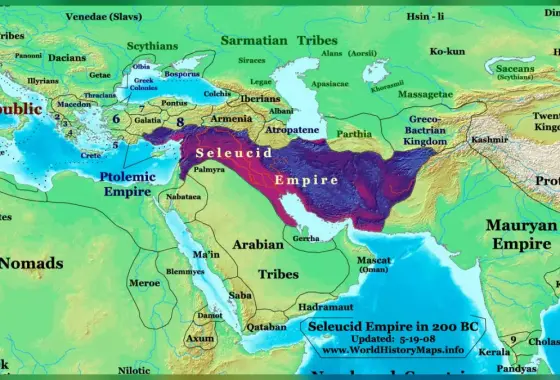
After Alexander the Great’s death his generals fought to divide the empire. One of them, Seleucus, took Babylon in 312 BC, the date taken as the start of the Seleucid era. Seleucus soon controlled the eastern lands reaching Iran and Central Asia.
India and Antioch
Seleucus made a treaty with Chandragupta, founder of the Maurya Empire in India, ceding him the Indus region in exchange for hundreds of war elephants. After the Battle of Ipsus in 301 BC he also took northern Syria, and in 300 BC he founded Antioch (Antakya) on the Orontes River. Antioch became one of the largest cities of the eastern Mediterranean in later centuries.
Hellenistic culture
The Seleucids spread Greek language and culture across the Middle East and Central Asia. Greek-style theatres and gymnasia were built in many of the cities they founded, and there was intense interaction between Greek and Eastern cultures.
Rome and decline
Antiochus III (222–187 BC) strengthened the empire again with great campaigns in the east, but in the west he clashed with Rome. In 190 BC he was defeated by a Roman army at Magnesia, near today’s Manisa, and under the Treaty of Apamea lost his Anatolian lands north and west of the Taurus. In the east, the Parthians took Iran and Mesopotamia.
End
Weakened by dynastic struggles in the 2nd and 1st centuries BC, the state was reduced to Syria. In 63 BC the Roman general Pompey made Syria a Roman province, ending the Seleucid dynasty.
Sources and further reading
- Polybius, Histories.
- Livy, Ab Urbe Condita, book XXXVII (Magnesia).
- Encyclopaedia Britannica, “Seleucid kingdom”.
People also ask
What was the Seleucid Empire? The Seleucid Empire was founded in 312 BC by Seleucus I, one of Alexander the Great’s generals.
When was the Seleucid Empire founded? Founded: 312 BC, Seleucus I Nicator.
What was the Seleucid Empire’s capital? Capitals: Seleucia on the Tigris, Antioch.
When did the Seleucid Empire reach its greatest extent? Greatest extent: From Anatolia to Central Asia.


Leave a comment
Your email address will not be published. Required fields are marked *