



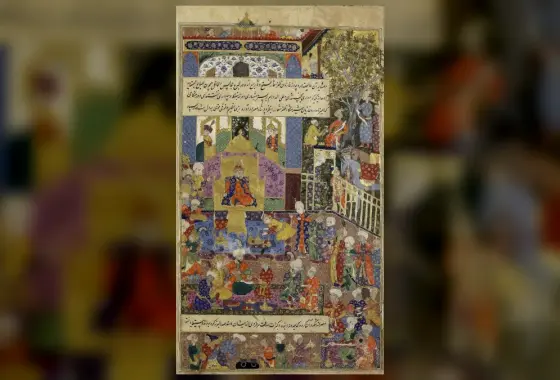
The Kara Koyunlu were a confederation of Turkmen tribes of Oghuz origin. In the second half of the 14th century, under Bayram Khoja, they grew strong in the region between the north of Lake Van and Mosul. At first they were subject to the Jalayirids.
Kara Yusuf and Timur
Facing Timur’s attacks, Kara Yusuf had to take refuge with the Mamluks. After Timur’s death in 1405 he returned, took Tabriz in 1406 and in 1410 defeated the Jalayirid Sultan Ahmad, becoming master of Azerbaijan and Iraq. He died in 1420 while fighting the Timurid Shah Rukh.
Jahan Shah
Kara Yusuf’s son Jahan Shah (1438–1467) began by coming to terms with the Timurids but soon won successes against them, conquering most of Iran and briefly reaching Herat in 1458. He was also a poet who wrote in Turkish and Persian under the pen name “Haqiqi”. The Blue Mosque of Tabriz, famous for its tilework, was built in his reign in 1465.
End
In 1467 Jahan Shah marched against the Aq Qoyunlu ruler Uzun Hasan but was defeated in a surprise attack near Muş and killed. His sons tried to resist for a short time, but by 1468 the Kara Koyunlu lands had passed to the Aq Qoyunlu.
Structure and origins of the confederation
The Kara Koyunlu were less a single dynasty than a confederation formed by Turkmen tribes of Oghuz origin. Bayram Khwaja and the later leaders who headed these tribes gained strength in the second half of the 14th century around Lake Van, in the highland pastures of eastern Anatolia and Azerbaijan. These semi-nomadic communities spent winters in plains and valleys and summers in highland pastures, living from herding. The name Kara Koyunlu, meaning “black sheep”, may derive from a black sheep on their banners or among their flocks, but the sources give no firm explanation of the name.
The administration of this confederation rested less on a central bureaucracy than on relations among tribal leaders. The ruler remained strong as long as he kept the tribes’ support; when that support weakened, the state dispersed quickly. The political success of the Kara Koyunlu came from their ability to use this flexible structure as a balancing factor among great powers such as the Jalayirids, the Timurids and the Mamluks.
The capture of Tabriz and the fall of the Jalayirids
Kara Yusuf’s capture of Tabriz in 1406 is regarded as the moment when the Kara Koyunlu changed from a regional force into a state. Timur’s death in 1405 had created a power vacuum in the Middle East; Kara Yusuf took advantage of it and came to dominate Azerbaijan. Tabriz became the Kara Koyunlu capital and trade centre; its position on the western branch of the Silk Road brought the city great revenue.
His defeat of the Jalayirid Sultan Ahmad in 1410 was one of Kara Yusuf’s most important successes. Baghdad and Iraq thereby came under Kara Koyunlu rule. This expansion, however, made conflict with powerful rivals such as Timur’s son Shah Rukh unavoidable. Kara Yusuf died in 1420 while preparing to face Shah Rukh’s army. This shows that a power struggle began after the founding generation; the dynasty’s next great ruler, however, largely overcame these problems.
Jahan Shah’s rule and culture
Jahan Shah (1438–1467) was the longest-reigning and strongest ruler of the Kara Koyunlu. Taking advantage of rivalries in the Timurid family, he captured a large part of Iran; his advance as far as Herat in 1458 shows that the state reached its widest borders. This expansion gave him a military advantage over the Timurids but also made administration more complex. To govern such a vast territory, Jahan Shah appointed his sons as governors in various regions, which later triggered struggles within the dynasty.
Jahan Shah was also a poet who wrote Turkish and Persian poems under the pen name “Haqiqi”. This shows that Turkmen rulers were active not only in military but also in literary and artistic fields. The Blue Mosque of Tabriz, built in 1465 and famous for its tiles, is among the best-known architectural works of this period. While reflecting the artistic sensibility of the Kara Koyunlu era, the building represents a tile tradition that also influenced later Iranian and Anatolian architecture. The surviving parts of the monument have been restored over the years because the region has been damaged by earthquakes.
Collapse against Uzun Hasan
In Jahan Shah’s final years the Kara Koyunlu state began to weaken against its rival, the Ak Koyunlu. The Ak Koyunlu ruler Uzun Hasan had grown strong around Diyarbakır and, with the support of the Timurids and Ottomans, had pressed the Kara Koyunlu. When Jahan Shah set out against Uzun Hasan in 1467, he was at serious risk because of winter conditions and the scattered state of his army. He was defeated and killed in a raid near Muş.
After Jahan Shah’s death a struggle for the throne broke out among his sons, and Uzun Hasan took advantage of this confusion. By 1468 the Kara Koyunlu lands had largely passed into Ak Koyunlu hands. This was the end of the long rivalry between the two Turkmen confederations. Although the Kara Koyunlu had ended politically, their architectural and literary heritage in Tabriz inspired the later Safavid period. They are therefore regarded in Middle Eastern history not just as a transitional state but as a link ensuring cultural continuity.
Economy, society and comparison with the Ak Koyunlu
The Kara Koyunlu economy rested on herding and trade. While cities such as Tabriz drew revenue from trade along the Silk Road, the Turkmen tribes in rural regions were tied to the state through the pasture and tax system. Merchants, craftsmen and scholars in the cities worked under the rulers’ patronage, so a balance was struck between the nomadic military aristocracy and the settled urban population. This balance could be sustained under strong rulers such as Jahan Shah and broke down when central authority weakened.
The Kara Koyunlu are often compared with their rivals, the Ak Koyunlu. Both confederations were based on Turkmen tribes of Oghuz origin, but the Ak Koyunlu developed mostly around Diyarbakır, in contact with the Byzantines and Ottomans, while the Kara Koyunlu rose in Azerbaijan and Iraq in close relation with the Timurids. Because most sources came from Ak Koyunlu and Timurid pens, judgments about the Kara Koyunlu can sometimes be biased against them. Modern research tries to set these judgments in a more balanced framework and suggests studying the dynasty’s artistic and architectural heritage more widely.
Sources and further reading
- Türkiye Diyanet Vakfı İslâm Ansiklopedisi, “Karakoyunlular”.
- Faruk Sümer, Kara Koyunlular.
- Encyclopaedia Britannica, “Kara Koyunlu”.
- Türkiye Diyanet Foundation Encyclopaedia of Islam – “Karakoyunlular” entry
- Faruk Sümer – Kara Koyunlular
- Encyclopaedia Britannica – Kara Koyunlu
- Türkiye Diyanet Foundation Encyclopaedia of Islam – “Karakoyunlular” entry
- Faruk Sümer – Kara Koyunlular
- Encyclopaedia Britannica – Kara Koyunlu
People also ask
What was the Kara Koyunlu? The Kara Koyunlu (“Black Sheep”) was a Turkmen state founded in the second half of the 14th century in the region between Lake Van and Mosul.
When was the Kara Koyunlu founded? Founded: c. 1375, between Van and Mosul.
What was the Kara Koyunlu’s capital? Capital: Tabriz.
When was the Kara Koyunlu at its height? Height: Reign of Jahan Shah (1438 – 1467).
Leave a comment
Your email address will not be published. Required fields are marked *