



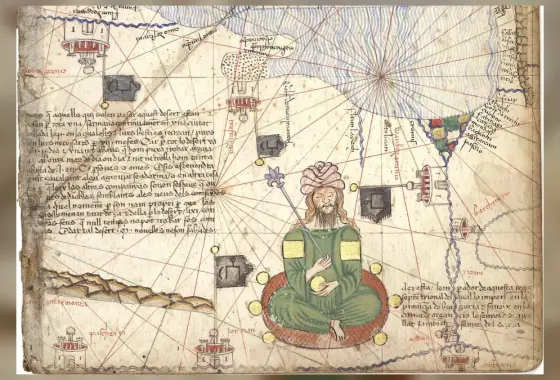
When Genghis Khan divided his lands among his sons, he gave the westernmost region to his eldest son Jochi. Jochi’s son Batu, after the western campaign of 1236–1242, founded the city of Sarai on the lower Volga as the centre of the khanate. Known in Russian sources as the “Golden Horde”, the state is usually called the “Ulus of Jochi” in its own sources.
The Rus principalities
Rather than ruling the Rus principalities directly, the Golden Horde made them tributaries. Princes had to obtain a yarlyk (patent) from the khan to rule. This period is known in Russian history as the “Tatar yoke”.
Turkicisation and Islamisation
Most of the khanate’s population were Kipchak Turks, and the Mongol ruling class gradually became Turkic. Berke Khan was among the first Mongol rulers to become Muslim and allied with the Mamluks against the Ilkhanate. Under Uzbek Khan (1313–1341) Islam became the state religion, a period seen as the khanate’s peak.
Decline and break-up
Internal turmoil and plague in the mid-14th century weakened the state. In 1380 it was defeated at Kulikovo by Prince Dmitry of Moscow. Tokhtamysh Khan restored unity and burned Moscow in 1382, but was defeated by his former ally Timur in 1391 and 1395, and Sarai was destroyed. In the 15th century the khanates of Kazan, Crimea and Astrakhan broke away. The remaining “Great Horde” was destroyed in 1502 by the Crimean khan Meñli Giray.
The city of Saray and the Volga trade route
The khanate's centre, Saray, was founded on the lower Volga in today's Astrakhan region; in the 14th century a second capital, "New Saray", grew further north. Ibn Battuta, who visited the region in the 1330s, describes Saray with its broad streets, markets and quarters belonging to different peoples. The Golden Horde linked the overland routes along the Volga and Don to the Black Sea ports: the Genoese set up trading colonies at Caffa in Crimea and the Venetians at Tana near Azov. Furs, grain, salt and silk passed along these routes, and a large part of the Mamluk sultanate's need for soldiers in Egypt was met from the Kipchak steppe.
Yarliqs, census and the yam: the system of rule
The khanate controlled its tributary lands through tax officials and local rulers. Russian chronicles record that a census for tax purposes was carried out in the lands of Vladimir-Suzdal and Novgorod in 1257–1259. Yarliqs issued in the khan's name were granted not only to princes but also to the Orthodox Church, which in return for tax exemption was obliged to pray for the khan. The yam system of relay stations, inherited from the Mongol Empire, allowed news and envoys to travel quickly across the vast steppe. These institutions left traces in Russian too: words such as "yamshchik" (coachman), "tamozhnya" (customs, from the word tamga) and "denga" (money) date from this period.
Kipchak, the Codex Cumanicus and literature
The common language of the khanate was Kipchak Turkic. The 14th-century Codex Cumanicus is a Latin-Persian-Kipchak dictionary and collection of texts prepared for Italian merchants and missionaries; it is kept today in the Marciana Library in Venice. Turkic literature also flourished around the Golden Horde: Qutb adapted Nizami's Khusraw and Shirin into Turkic in 1341–1342 and presented it to Tinibeg Khan, and Khwarazmi's Muhabbatnama was written in 1353 for a Golden Horde emir. These works are key sources for the development of the Turkic written language in Khwarazm and the Volga basin.
Successor khanates and lasting legacy
As the Golden Horde broke apart, new Turkic khanates arose in its place: Kazan (around 1438), Crimea (around 1441), Astrakhan and the Nogai Horde were the main ones. As the Grand Principality of Moscow grew stronger, these khanates changed hands one by one: Kazan fell to Ivan the Terrible in 1552 and Astrakhan in 1556, while the Crimean Khanate was annexed by Russia in 1783. Today the Golden Horde is seen as a common starting point in the history of peoples such as the Tatars, Bashkirs, Crimean Tatars and Nogais. Historians also frequently debate the influence of this period on the formation of the Russian state's tax, postal and customs systems.
Sources and further reading
- Türkiye Diyanet Vakfı İslâm Ansiklopedisi, “Altın Orda”.
- Ibn Battuta, Travels (account of Uzbek Khan’s court).
- Encyclopaedia Britannica, “Golden Horde”.
- István Vásáry – Cumans and Tatars: Oriental Military in the Pre-Ottoman Balkans, 1185–1365 (Cambridge University Press, 2005)
- Bertold Spuler – Die Goldene Horde: Die Mongolen in Russland 1223–1502 (1943; enlarged edition 1965)
People also ask
What was the Golden Horde? The Golden Horde was the khanate founded on the Volga in the 1240s by Batu Khan, a grandson of Genghis Khan.
When was the Golden Horde founded? Founded: c. 1242, Batu Khan.
What was the Golden Horde’s capital? Capital: Sarai (lower Volga).
When did the Golden Horde end? End: 1502, fall of the Great Horde.





Leave a comment
Your email address will not be published. Required fields are marked *