



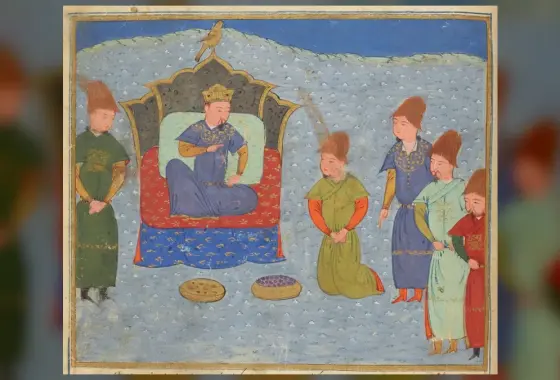
Batu was one of the sons of Jochi. After his father’s death in 1227 he became leader of the Ulus of Jochi. Russian sources also call him “Sain Khan” (the good khan).
The western campaign
The kurultai of 1235 decided on a great campaign to the west, with Batu at its head and the skilled general Subutai at his side. The Mongol army defeated the Volga Bulgars and the Kipchaks, then took Ryazan, Vladimir and most Rus cities. Kiev fell in 1240. In 1241 one column defeated a European army at Legnica in Poland, while the main army under Batu won at Mohi in Hungary.
Withdrawal and the Golden Horde
Following news of the great khan Ögedei’s death, among other reasons, Batu withdrew from central Europe in 1242. He settled on the lower Volga and founded the city of Sarai, which became the centre of the Golden Horde, and began granting patents (yarlyks) to Rus princes.
His place in Mongol politics
As one of the senior members of the family, Batu played a decisive role in electing great khans; in 1251 he backed the election of his cousin Möngke. He died around 1255 and, after short-lived rulers, was succeeded by his brother Berke.
The city of Sarai and the name "Golden Horde"
Sarai, founded by Batu on the lower Volga, was a centre that combined nomadic government on the steppe with settled trade. The remains of the city lie today in Russia's Astrakhan region, near the village of Selitrennoye, and are being studied archaeologically. Sarai stood at a point where trade routes between Eastern Europe, Central Asia and Iran crossed.
The name "Golden Horde" was not an official name used at the time; it became widespread in Russian sources in later centuries. Contemporary sources mostly refer to the state as the "Ulus of Jochi". Batu's elder brother Orda ruled the eastern wing of the ulus, while the Qipchaq steppe and the Volga region were under Batu's direct rule.
Russian princes and European envoys
After the campaign the Russian principalities were brought under Mongol rule, and princes had to travel to Batu's court to keep their thrones.
- The yarlik: Yaroslav, prince of Vladimir, became in 1243 the first Russian prince to receive from Batu a yarlik (patent of rule) for the grand principality. His son Alexander Nevsky also travelled in 1247 to Sarai and from there to Karakorum.
- The papal envoy: The Franciscan Giovanni da Pian del Carpine, sent by the Pope, passed through Batu's camp in 1246 on his way to Karakorum and wrote one of the first detailed reports on the Mongols in Europe.
- William of Rubruck: This friar, who visited Batu in 1253, described the khan's camp as being like "a city on the move".
The Ulus of Jochi after Batu
The order Batu built outlived him by more than two and a half centuries. After his death his son Sartaq, and then the young Ulaghchi, held the throne for short periods; in 1257 his brother Berke became khan.
- Berke's reign: Berke was the first Jochid khan to convert to Islam. He fought the Ilkhanid ruler Hulagu over the pastures of the Caucasus and the sack of Baghdad, and in this conflict allied with the Mamluk Sultan Baybars of Egypt.
- Özbeg Khan: Under Özbeg Khan, who reigned from 1313 to 1341, Islam became permanently established among the ulus's ruling circles; this period is regarded as the state's strongest years.
- Decline: In 1395 the city of Sarai suffered great destruction during Timur's campaign. Over time the state broke up into khanates such as Kazan, Crimea and Astrakhan; the remnant of the Great Horde was eliminated in 1502 by the Crimean Khan Mengli Giray.
Sources and further reading
- Rashid al-Din, Jami al-Tawarikh.
- Türkiye Diyanet Vakfı İslâm Ansiklopedisi, “Batu Han”.
- Encyclopaedia Britannica, “Batu”.
- Giovanni da Pian del Carpine – Ystoria Mongalorum (1247)
- Christopher P. Atwood – Encyclopedia of Mongolia and the Mongol Empire (Facts on File, 2004)
- István Vásáry – Cumans and Tatars (Cambridge University Press, 2005)
- István Vásáry – Cumans and Tatars (Cambridge University Press, 2005)
- Encyclopaedia Britannica – "Golden Horde"
People also ask
Who was Batu Khan? Batu Khan was the son of Jochi, Genghis Khan’s eldest son.
When and where was Batu Khan born? Born: c. 1207.
When did Batu Khan die? Died: c. 1255.
Who was Batu Khan’s father? Father: Jochi (son of Genghis Khan).


Leave a comment
Your email address will not be published. Required fields are marked *