



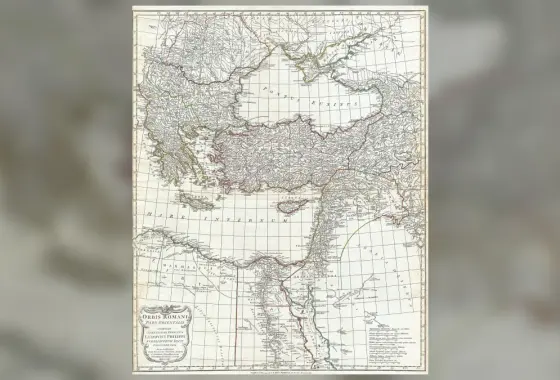
In 330 the Roman emperor Constantine I refounded the old city of Byzantium as Constantinople, the empire’s new capital. With the death of Theodosius I in 395 the empire was permanently divided into East and West. While the Western Empire fell in 476, the Eastern Empire survived for another thousand years. The name “Byzantine” was coined by European scholars in the 16th century; the Byzantines called themselves “Romaioi” (Romans).
Justinian and Hagia Sophia
Justinian I (527–565) recovered Italy, North Africa and part of Spain. The Corpus Juris Civilis, compiling Roman law, was produced in his reign and remains a foundation of European law. Hagia Sophia, completed in 537, was the world’s largest domed building for nearly a thousand years.
Arabs, Bulgars and the Macedonian dynasty
In the 7th century, after long wars with the Sasanians, Syria, Palestine and Egypt were lost to the Arab conquests, and Constantinople was besieged several times. The Iconoclasm controversy of 726–843 deeply divided society. Under the Macedonian dynasty in the 9th–11th centuries the empire grew strong again; Basil II destroyed the Bulgarian Empire.
Decline
After the defeat at Manzikert in 1071, most of Anatolia passed to the Turks. In 1204 the armies of the Fourth Crusade sacked Constantinople and set up a Latin Empire; the Byzantines recovered the city only in 1261. In its last centuries, under the Palaiologos dynasty, Byzantium was squeezed into Constantinople and small territories around it.
The conquest of Constantinople and legacy
On 29 May 1453 the Ottoman sultan Mehmed II conquered Constantinople; the last emperor, Constantine XI, died on the walls. Through Roman law, the preservation of Greek classics, Orthodox Christianity and its art, Byzantium deeply influenced Eastern Europe, Russia and Ottoman culture.
Constantinople: walls, cisterns and the Hippodrome
Because Constantinople stood on a peninsula where land and sea trade routes met, it was naturally defended. The land walls built in the early 5th century under Theodosius II protected the city against many sieges for about a thousand years. The chain stretched across the mouth of the Golden Horn and the incendiary mixture known as “Greek fire” were important parts of the sea defense.
At the heart of the city stood the Great Palace, Hagia Sophia and the Hippodrome. The Hippodrome was a place of chariot racing where the people met the emperor face to face, and the Nika revolt of 532 began there. Large underground water stores such as the Basilica Cistern were designed to supply the city’s water even during a siege.
State, law and the church
The Byzantine emperor bore the title “basileus” and saw himself as God’s representative on earth. Even so, the throne was never tied to a single dynasty; the army, the senate and the people played a part in choosing emperors at different times. The “theme” system set up in the 7th century organized provincial defense by giving soldiers land. From the time of Heraclius, Greek replaced Latin as the official language.
Church and state were closely linked, and the emperor had a say in religious matters as well. The patriarch of Constantinople was among the most respected figures of the Eastern Orthodox world. Disagreements with the papacy in Rome ended in the split known as the “Great Schism” of 1054, after which the Catholic and Orthodox churches went separate ways.
Economy, art and influence on the Slavic world
The symbol of the Byzantine economy was the gold “solidus” coin, which kept its value for more than four hundred years. The city was a crossroads of trade in silk, spices and luxury goods. According to tradition, silkworm eggs were brought from China in the time of Justinian, starting silk production within the empire. The state closely supervised the trade in some goods.
In art, mosaics, icons and illuminated manuscripts stand out. With the domed plan of Hagia Sophia, Byzantine architecture influenced both Orthodox churches and Ottoman mosques in later centuries. In the 9th century the work of Cyril and Methodius among the Slavs laid the foundation for Slavic alphabets. Prince Vladimir of Kiev’s choice of Christianity in 988 set the cultural direction of Russia and Eastern Europe.
The Komnenoi, the Latin occupation and the Palaiologoi
Alexios I Komnenos, who took the throne at the end of the 11th century, put together a state that had fallen apart after Manzikert. The Komnenian dynasty regained strength in the army and in diplomacy for about a century, but relations with the Crusader armies were a source of both help and mistrust. The sack of Constantinople by the Latins in 1204 broke the empire into pieces; successor states such as Nicaea, Trebizond and Epirus tried to carry on the Byzantine inheritance.
In 1261 the Empire of Nicaea retook Constantinople and the Palaiologan era began. The state was now much smaller; civil wars, the plague that spread from 1347 and the Ottoman advance in the Balkans weakened it further. Yet the Palaiologan age was lively in literature, philosophy and art, and the migration of Byzantine scholars to Italy contributed to the Renaissance.
Byzantium’s legacy and the idea of “Byzantine”
One of Byzantium’s most important contributions is the preservation of ancient Greek and Roman texts. Libraries and monasteries in Constantinople copied the works of Plato, Aristotle and many historians over the centuries. These manuscripts later reached Italy and fed Renaissance thought. The codification of Roman law also shaped Europe’s legal tradition.
The word “Byzantine” is often used to mean needless complexity and intrigue, and modern historians criticize this prejudice. The empire’s own citizens considered themselves Romans, and in Ottoman times the Greek Orthodox community and the Patriarchate at Fener remained in Istanbul. Today the Byzantine legacy lives on through buildings such as Hagia Sophia, Chora and the city walls, and through the traditions of Orthodox churches in Eastern Europe.
Traces of Byzantium also survive in Istanbul’s present skyline and district names: the Theodosian walls, the Binbirdirek and Basilica cisterns, and the districts of Fener and Balat remind residents of the city’s thousand-year Eastern Roman past in everyday life.
Sources and further reading
- Encyclopaedia Britannica, “Byzantine Empire”.
- George Ostrogorsky, History of the Byzantine State.
- UNESCO World Heritage, “Historic Areas of Istanbul”.
- John Julius Norwich – A Short History of Byzantium (Knopf, 1997).
- Türkiye Diyanet Foundation Encyclopaedia of Islam, “Bizans” entry.
- Encyclopaedia Britannica, “Byzantine Empire” entry.
People also ask
What was the Byzantine Empire? The Byzantine Empire was the continuation of the eastern half of the Roman Empire, with its capital at Constantinople (Istanbul).
What was the Byzantine Empire’s capital? Capital: Constantinople (Istanbul).
When did the Byzantine Empire end? End: 29 May 1453, conquest of Constantinople.





Leave a comment
Your email address will not be published. Required fields are marked *