



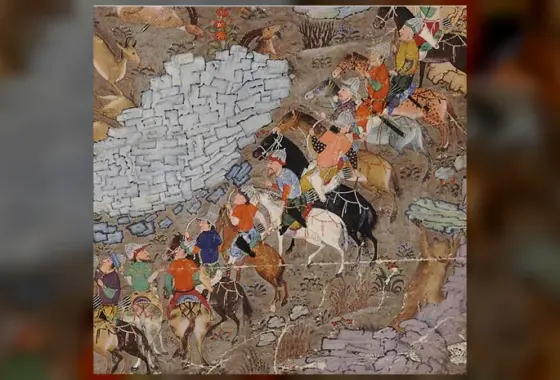
The Aq Qoyunlu were a confederation of Turkmen groups led by the Bayındır tribe of the Oghuz. Some explain the name by a white sheep emblem on their banners, others by the white sheep they raised. In the late 14th century they grew strong in the area between Diyarbakır, Mardin and Erzincan.
Kara Yülük Osman Bey
Kara Yülük Osman Bey, regarded as the state’s true founder, sided with Timur during his Anatolian campaign, and after the Battle of Ankara in 1402 the Diyarbakır region was left to him. He then had to fight a long struggle with the Kara Koyunlu to the east.
Uzun Hasan
Uzun Hasan (1453–1478) defeated the Kara Koyunlu ruler Jahan Shah in 1467 and the Timurid ruler Abu Sa‘id in 1469, becoming master of Iran, Iraq and Azerbaijan, and moved his capital to Tabriz. He established diplomatic ties with Venice against the Ottomans. His tax regulations, the “Laws of Hasan Padishah”, influenced later Ottoman and Safavid practice.
Otlukbeli
Uzun Hasan, who backed the Karamanids and rivalled the Ottomans in eastern Anatolia, was defeated by the army of Mehmed the Conqueror at Otlukbeli near Erzincan on 11 August 1473. Ottoman artillery was decisive, and the battle consolidated Ottoman supremacy in eastern Anatolia.
End
After Uzun Hasan’s death, succession struggles weakened the state. In 1501 Shah Ismail defeated the Aq Qoyunlu at Sharur and took Tabriz, and by 1503 most Aq Qoyunlu lands had passed to the Safavids. Shah Ismail’s mother was a daughter of Uzun Hasan.
State structure and society
The Aq Qoyunlu were a confederation built on the military strength of nomadic Turkmen tribes. Tribal chiefs were bound to the ruler, but that bond depended heavily on a strong ruler and on success in war. Sources describe how Uzun Hasan tried to turn this structure into a more orderly state centred on Tabriz, issuing laws on taxation and administration.
The population was not made up of Turkmens alone. The cities were home to Persian-speaking scribes and officials, merchants, craftsmen and several Christian communities. This mixed structure created tension between the Turkmen military aristocracy and the settled administrators, but it also allowed the state to draw revenue from trade routes and urban economies.
Uzun Hasan’s diplomacy and marriage ties
Uzun Hasan regarded the rise of the Ottomans as a threat that upset the balance in the region. The Ottoman conquest of the Greek Empire of Trebizond in 1461 mattered to him personally, because his wife Despina Khatun was the daughter of the emperor of Trebizond. His relations with the Republic of Venice grew out of a search for an alliance against the common Ottoman enemy.
Venetian envoys travelled to and from Tabriz, and Uzun Hasan was promised firearms and artillery, but this support remained largely limited. The dynasty also built ties through marriage: Uzun Hasan’s daughter married Haydar, the sheikh of the Safavid order. The child born of this marriage was Shah Ismail, who would later found the Safavid state.
Successors and internal rivalries
When Uzun Hasan died in 1478, the state immediately felt the absence of a strong ruler. The struggle for the throne among his sons led tribal chiefs to take sides against each other. After a few short reigns, Yaqub Beg (1478–1490) took the throne and stabilised the state for a time, but rivalry among members of the dynasty flared up again after his death.
These disputes made it hard to maintain order along the frontiers of eastern Anatolia and Iran. As central authority weakened, local lords began to act independently in practice. This internal wearing down reduced the state’s capacity to resist a new force emerging from outside.
The Safavid rise and the legacy
The Safavid order, which gathered strength in Ardabil, rose against the Aq Qoyunlu with the support of the Qizilbash Turkmen tribes. The young Shah Ismail defeated the Aq Qoyunlu ruler Alvand at the Battle of Sharur in 1501, entered Tabriz and declared himself shah. The Aq Qoyunlu presence effectively ended in 1503 after the fighting near Hamadan.
Although the state disappeared, its influence continued. The Safavids took over a large part of the Aq Qoyunlu administrative tradition, and Tabriz and its surroundings remained the political centre of the region. Uzun Hasan’s laws and tax practices left traces in later Ottoman and Safavid administration. Today the Aq Qoyunlu are remembered as a bridge of the Turkmen state tradition between Anatolia and Iran.
Economy, trade and cities
The importance of the Aq Qoyunlu lands came from their position at the crossroads of trade routes between Anatolia, Iran and Mesopotamia. Tabriz was among the liveliest market cities at the western end of the Silk Road; cloth, spices and handicrafts were carried from there to the Black Sea ports and the Mediterranean. The rulers drew significant income from customs and trade taxes.
Herding formed the basis of the livelihood of the Turkmen tribes. Flocks moving between summer and winter pastures supplied meat and dairy products and sustained the capacity to field mounted soldiers. Still, the sharing of income between the nomadic and the settled parts of society was often a matter of dispute.
Culture, architecture and literature
Under Uzun Hasan, building palaces, mosques and madrasas in Tabriz received attention, and the city hosted an artistic and literary environment that continued Timurid culture. Persian and Turkish poetry lived side by side at court, and calligraphy, miniature painting and the art of the book kept developing in the workshops of the region.
Aq Qoyunlu miniature and book production is regarded as one of the preparers of later Safavid art. The rulers also patronised religious scholars and Sufis. This layered cultural heritage allowed the region to share a common artistic language in the following century even as political borders changed.
Army and warfare
The core of the Aq Qoyunlu army was made up of Turkmen mounted archers. In campaign season the rulers gathered troops from tribal chiefs and, after the war, shared spoils and land revenue with them. This system suited fast campaigns but created problems of discipline and supply in long wars.
The defeat at Otlukbeli showed the limits of this traditional structure against firearms and artillery. Uzun Hasan had expected artillery help from Venice, but the Ottoman army’s regular infantry and guns proved decisive. This experience raised the need for central, regular units in Aq Qoyunlu military culture.
Sources and further reading
- Türkiye Diyanet Vakfı İslâm Ansiklopedisi, “Akkoyunlular” and “Uzun Hasan”.
- John E. Woods, The Aqquyunlu: Clan, Confederation, Empire.
- Encyclopaedia Britannica, “Ak Koyunlu”.
- John E. Woods – The Aqquyunlu: Clan, Confederation, Empire
- Encyclopaedia Iranica – “Aq Qoyunlu”
- Türkiye Diyanet Foundation Encyclopaedia of Islam – “Akkoyunlular” entry
- John E. Woods – The Aqquyunlu: Clan, Confederation, Empire
- Encyclopaedia Iranica – “Aq Qoyunlu”
- Türkiye Diyanet Foundation Encyclopaedia of Islam – “Akkoyunlular” entry
People also ask
What was the Aq Qoyunlu? The Aq Qoyunlu (“White Sheep”) was a Turkmen state founded around Diyarbakır in the late 14th century under the leadership of the Bayındır tribe.
When was the Aq Qoyunlu founded? Founded: c. 1378, Diyarbakır region.
What was the Aq Qoyunlu’s capital? Capitals: Diyarbakır, later Tabriz.
When was the Aq Qoyunlu at its height? Height: Reign of Uzun Hasan (1453 – 1478).
Leave a comment
Your email address will not be published. Required fields are marked *