



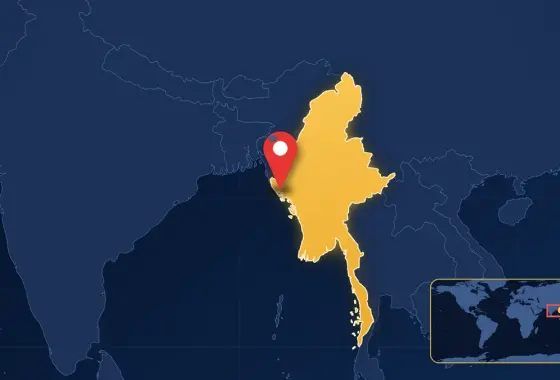
The International Court of Justice (ICJ), the highest judicial body of the United Nations, ruled in The Hague on Thursday, 19 November 2026, that Myanmar committed genocide against the Rohingya community in the north of Rakhine State. Reading the judgment over about three hours, Court President Yuji Iwasawa announced that Myanmar “has committed genocide against the Rohingya group in northern Rakhine state.” According to Al Jazeera, the decision was taken by 9 votes to 6 in the 15-judge bench. It is the first ruling in which a state has been held directly responsible for genocide at the ICJ.
The court said that the “only reasonable inference” to be drawn from the evidence taken as a whole was that Myanmar’s security forces acted with intent to destroy a “substantial part” of the Rohingya minority. According to Iwasawa, the evidence shows that Myanmar’s forces killed some 10,000 Rohingya. According to The Jerusalem Post, the court also found that the security forces killed thousands of civilians, committed widespread sexual violence, used extreme violence against children and attacked Rohingya fleeing to Bangladesh.
How did the case begin?
The West African nation of The Gambia filed the case on 11 November 2019 with the backing of the Organisation of Islamic Cooperation (OIC). The Gambia argued that Myanmar had breached the 1948 Convention on the Prevention and Punishment of the Crime of Genocide. Article 9 of the convention allows disputes between states parties to be brought before the ICJ, which is why a country that was not directly harmed was able to bring the case. The Gambia asked the court to find that Myanmar had breached the convention, to order it to stop unlawful acts against the Rohingya and to ensure that those responsible are punished.
In January 2020, the court ordered Myanmar to take provisional measures to protect the Rohingya. Myanmar’s objections to the court’s jurisdiction were rejected in full in July 2022. Hearings on the merits were held from 12 to 29 January 2026. Myanmar has rejected the genocide accusations from the outset and argues that its 2017 military operations were a response to attacks on police posts by fighters of the Arakan Rohingya Salvation Army (ARSA).
What happened in 2017?
The campaign that Myanmar’s military launched in Rakhine State in August 2017, described as “clearance operations”, drove more than 730,000 mainly Muslim Rohingya to flee to neighbouring Bangladesh. According to UN figures, more than 1.3 million Rohingya are displaced across South and Southeast Asia today, about 1.2 million of them in camps in Bangladesh’s Cox’s Bazar area. Shrinking humanitarian aid, conflict and dangerous sea crossings are making conditions in the camps even harder.
The Rohingya are recognised as a minority that has been denied basic rights in Myanmar for decades, citizenship above all. A 1982 citizenship law left most of the community effectively stateless. This background was also treated as important context in the court’s assessment of “intent”: according to The Jerusalem Post, the court said the context of the 2017 operations created an atmosphere conducive to violence and formed the basis of the intent to destroy part of the group.
Why is the ruling considered historic?
In genocide cases, the hardest element to prove is the specific intent to destroy a group “in whole or in part”. International human rights lawyer Toby Cadman, speaking to Al Jazeera, noted that the ICJ had never before ruled that a state had specific intent to commit genocide. In 2007, in the Bosnia and Herzegovina v. Serbia case, the court found that the Srebrenica massacre was genocide but did not find sufficient evidence that Serbia itself had committed it, ruling only that it had breached its duty to prevent genocide.
According to Al Jazeera’s correspondent in The Hague, at least four genocidal acts were proven in this case: the mass killing of civilians, the forced displacement of hundreds of thousands of people, causing serious bodily and mental harm to the group, and preventing births. The court also said that once armed civilians joined the military campaign, Myanmar should have known of the risk of genocide and therefore also breached its duty to prevent it. The ruling is one of only a handful of decisions since the Second World War in which an international court has found that genocide was committed.
How will the ruling be enforced?
ICJ judgments are final and cannot be appealed, but the court has no enforcement power of its own. If Myanmar does not comply, The Gambia can turn to the UN Security Council under Article 94 of the UN Charter. In the Council, however, the veto power of permanent members could limit possible sanctions. Cadman said the ruling “is not the end of the matter” and that much depends on whether the case goes to the Security Council, whether sanctions are imposed and what other remedies the court may set out. Details on reparations and other obligations will become clear with the court’s official publication of the judgment.
Separately from this case, the International Criminal Court (ICC) is investigating individual criminal responsibility for the deportation of Rohingya to Bangladesh. The ICJ handles disputes between states, while the ICC tries individuals; the two processes are therefore seen as complementary but distinct legal paths.
What does this mean?
The ruling is the first concrete example showing that the Genocide Convention can hold not only individuals but also states responsible. This could set an important precedent for other genocide cases pending before the court. For the Rohingya, the impact on the ground will depend on the steps taken by the international community: conditions for safe and voluntary return, citizenship rights and the continuation of humanitarian aid in the camps will be the most critical issues in the period ahead. Legal debate is also expected to deepen as the full reasoned judgment and the opinions of the dissenting judges are published.
This report was compiled as of 19 November 2026, 15:30 Türkiye time; follow developments as they are updated.
Frequently asked questions
What did the ICJ rule on Myanmar?
The International Court of Justice ruled that Myanmar committed genocide against the Rohingya community in northern Rakhine State and breached its duty to prevent genocide.
Who brought the case?
The Gambia brought the case on 11 November 2019 under the 1948 Genocide Convention, with the backing of the Organisation of Islamic Cooperation.
Can the ICJ ruling be appealed?
No. ICJ judgments are final and cannot be appealed; however, since the court has no enforcement power, non-compliance can be taken to the UN Security Council.
Sources and further reading
- Al Jazeera, “UN top court convicts Myanmar of ‘genocidal intent’ against Rohingya”, 19 November 2026.
- The Jerusalem Post, “World court rules on whether Myanmar committed genocide against Rohingya”, 19 November 2026.
- International Court of Justice, “The Gambia v. Myanmar” case page (case no. 178).
Leave a comment
Your email address will not be published. Required fields are marked *