



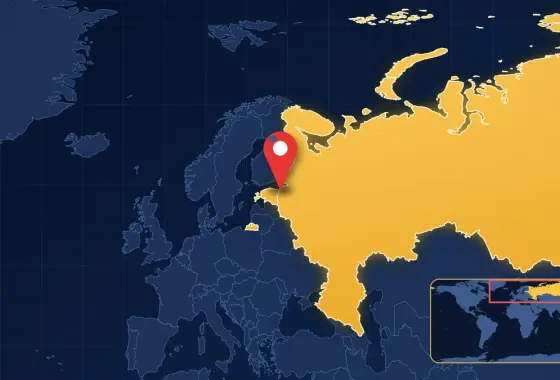
Estonia’s government on Friday, 20 November 2026, approved closing its road border crossings with Russia for six months. According to Al Jazeera, the closure is preliminary, will begin on 1 December and a decision on any extension will be taken next year. Euronews wrote that a review is possible at the end of the six months. Rail freight is not affected, but it will continue under strict customs checks.
The decision is among the most direct steps a small Baltic member of NATO and the EU can take against Russia, with which it shares a long land border. Moscow described the move as an attempt to build a “new Iron Curtain” and said it would respond.
The incident behind the decision
Tallinn’s justification is an incident on the night of 14 to 15 November in Viimsi, near the capital. According to Euronews, an arson attempt on Threod Systems, a defence and drone facility, caused no damage to production or products. Estonia says the attack was ordered by Russian military intelligence, the GRU, and eight people from Latvia were detained. Estonia’s Internal Security Service said Russian services had authorised two attacks on Estonian defence firms this year. The Kremlin denied any involvement.
Which crossings are closing?
The two sources paint a slightly different picture of the scope. Euronews lists five crossings, Narva-1, Narva-2, Koidula, Luhamaa and Saatse, and says only Narva, Luhamaa and Koidula were in active use. Al Jazeera describes the step as covering all crossings to the “east and south” towards Russia. Russia had already suspended road traffic at Narva in February 2024, although pedestrian crossings remained open. The practical effect of the decision therefore depends less on the names of the crossings than on which ones were still actively used.
How many people cross?
According to Estonian police data, 760,000 crossings were made at the border this year. Of these, 307,000 were by Russian nationals, 175,000 by Estonian citizens and 54,000 by holders of Finnish passports. In other words, the border is not just a security line; it is also the daily lifeline of people who live, work and have family ties across it. The closure will lengthen or redirect these journeys.
What Estonia says
Foreign Minister Margus Tsahkna called the decision “an important measure” and said it reduces Russia’s opportunities to recruit, run influence operations, sabotage and evade sanctions. Prime Minister Kristen Michal said Estonia would “not allow Russia to use our openness against us”. President Ülle Madise, for her part, urged the government not to act “under the influence of emotions” and acknowledged that the decision would mean extra work for the security service Kapo. This range of views shows that the decision is not entirely uncontested within Estonia, but that the government chose a line that puts its security reasoning first.
Moscow’s reaction
Russian Foreign Ministry spokesperson Maria Zakharova said that if Tallinn goes ahead, Moscow will take “necessary political and diplomatic measures” and described the step as an attempt to erect “a new Iron Curtain”. According to Euronews, the Foreign Ministry also called the decision “Russophobia”. The vocabulary refers back to the Cold War East–West divide; for the Estonian government, however, the issue is not a historical image but a direct security risk.
What are the neighbours doing?
Finland closed its crossings with Russia in 2023 and keeps them closed. According to Al Jazeera, Latvia and Lithuania keep their crossings open, while Euronews writes that Latvia, Lithuania and Poland have curtailed crossings. The difference between the sources suggests that countries have limited crossings to different degrees; Estonia’s decision stands out as one of the most comprehensive steps on the EU’s border with Russia.
What should be watched?
Several points will be worth following in the coming days: how the decision will be implemented on 1 December, what measures Russia announces in response and whether Estonia extends the closure at the end of the six months. The difficulties faced by people in border towns and by those who use the border in daily life, as well as the findings of the investigation into the arson attempt, will also test how solid the justification for the decision is. The figures and claims in this report are given as the sources relayed them; it should be remembered that the Kremlin denies any involvement and that the investigation continues.
What does this mean?
In the short term, the decision will affect transport and trade on the Estonia–Russia line and daily life around the border town of Narva in particular. On the security side, Tallinn is showing that it is ready to use the border as a tool against what are called hybrid threats: sabotage, recruitment and influence operations. Diplomatically, Moscow’s promise of a response may point to a new round of tension in bilateral relations. These readings, however, depend on official statements and on how events unfold; the practical consequences of the decision will become clear after 1 December.
This report was compiled as of 21 November 2026, 09:00 Türkiye time; figures and details may differ between sources and should be followed as developments are updated.
Frequently asked questions
What did Estonia decide?
The government approved closing its road border crossings with Russia for a preliminary six months; the closure begins on 1 December and a decision on an extension will be taken next year.
What triggered the decision?
An arson attempt, said to have been ordered by the GRU, on a defence firm, Threod Systems, near Tallinn. The Kremlin denies involvement.
Will rail freight be affected?
No. Rail freight is left out of the closure but will continue under strict customs checks.
How did Russia respond?
Zakharova said Moscow would take “necessary political and diplomatic measures” and that the step was an attempt to build a “new Iron Curtain”.
Sources and further reading
- Al Jazeera, “Russia complains of ‘new Iron Curtain’ as Estonia shuts its borders”, 20 November 2026.
- Euronews, “Estonia to shut border with Russia over GRU-linked sabotage attack”, 20 November 2026.



Leave a comment
Your email address will not be published. Required fields are marked *