



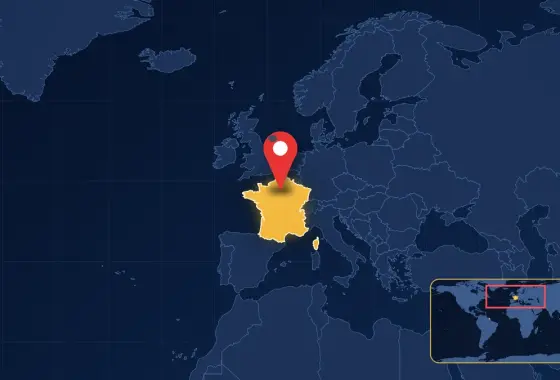
How did prices change in France in November?
According to data published by France’s official statistics institute Insee on Friday 27 November, consumer prices fell by 0.7% month-on-month in November 2026, following a 0.4% rise in October.
Insee said the slowdown was largely explained by the movement in energy prices. While energy prices are still showing a sharp increase compared with last year, they rose at a less rapid pace in November than in October, with the annual rate moving from 24.1% to 19.2%.
What is behind the fall in energy prices?
Insee particularly highlighted a marked fall in the prices of petroleum products, even as gas tariffs continued to rise. This shows that different items within the energy category are moving in opposite directions, with fuel getting cheaper while gas bills keep climbing.
Service inflation also eased to 2.3% year-on-year, down from 2.6% in October. Insee attributed the drop to a "sharp slowdown" in prices for accommodation and transport.
What is happening with food prices?
By contrast, Insee recorded a slight increase in food prices on a yearly basis, with food inflation rising to 1.3% in November from 1.2% in October. The increase was driven by a sharp rise in the fresh products category, where prices climbed to 9.4% year-on-year from 8% in October.
This picture shows that even as headline inflation eases, consumers are still feeling price pressure on fresh food items at the supermarket.
This acceleration in fresh product prices is usually linked to seasonal conditions, harvest yields and how energy costs feed through the farming and logistics chain, so a single month’s figure can also be read as a seasonal swing rather than a lasting trend in food inflation.
What do consumption and employment data show?
According to the same Insee release, French household spending on goods stabilised in November after falling in September and August. A 2.9% drop in energy consumption was offset by a 1.3% rebound in consumption of manufactured goods, while food consumption held broadly steady, down just 0.1%.
Salaried employment was flat this quarter (0.0%, or -12,200 jobs), a slight improvement from the previous quarter’s -0.1% (-26,100 jobs). However, employment continues to fall year-on-year for a fifth consecutive quarter. Insee noted that salaried employment still clearly exceeds its level before the health crisis at the end of 2019, by 4.8%, or 1.2 million jobs.
The drop in energy consumption offsetting the rebound in manufactured goods shows households largely maintained their overall spending level while reshuffling it between categories, pointing to consumer behaviour that adjusts flexibly to price movements.
How were GDP and household purchasing power affected?
Insee said France’s gross domestic product (GDP) fell by 0.2% in volume in the third quarter of 2026, after remaining stable the previous quarter, adding that the growth carry-over for 2026 stands at +0.1%.
By contrast, the purchasing power of households’ gross disposable income (RDB) per consumption unit rose by 0.2%, after a 0.5% fall in the previous quarter. The household saving rate stabilised in the third quarter at 17.4% of disposable income.
How should these figures be read?
Inflation slowing while GDP edged lower in the same quarter points to an economy in which price pressure is easing even as growth looks weak. Insee’s figures rest on official preliminary data, though such leading indicators are often revised in subsequent months.
The household saving rate staying relatively high, at 17.4%, suggests consumers remain cautious about spending rather than loosening their purse strings; whether this trend shifts will become clearer with Insee’s next data release in December.
How does France’s inflation compare with other major European economies?
The European Central Bank’s medium-term target for the euro area as a whole is an inflation rate of around 2%. France’s annual rate of 2.9% in November, while still above that target, can be read as a sign of gradual convergence toward it alongside the slowdown in energy prices.
France’s inflation outlook, together with price movements in other major eurozone economies such as Germany and Italy, remains one of the key inputs shaping the ECB’s coming interest-rate decisions; however, a single country’s data does not by itself determine the bloc-wide monetary policy decision.
Given the ongoing debate in France over its budget deficit and public debt, inflation staying under control means the government is not facing an extra squeeze on the price-stability front, at least, while it pursues its fiscal consolidation plans.
What is Insee, and how is inflation measured?
Insee (Institut national de la statistique et des études économiques) is France’s official statistics agency, regularly publishing key economic indicators such as inflation, employment, GDP and household consumption. It calculates the consumer price index (CPI) by tracking the prices of thousands of goods and services.
Insee’s monthly "preliminary results" are closely watched by economists and markets, though these figures are often subject to small revisions once final data is confirmed the following month.
What is the broader picture for the French economy in 2026?
France has gone through a period in 2026 marked by low growth and pressure on the public budget; the slight contraction in GDP in the third quarter fits that picture.
Inflation staying under control can be read as a positive signal for the European Central Bank’s monetary policy decisions, but weak growth and the year-on-year decline in employment also point to the economy’s fragility.
Why does the household saving rate matter?
The household saving rate shows how much of disposable income households set aside rather than spend. France’s rate staying above its historical average, at 17.4%, is read as a sign that consumers remain cautious amid economic uncertainty and are reluctant to spend.
A high saving rate can ease inflationary pressure in the short term, but it can also keep domestic demand, and therefore economic growth, weak, a picture consistent with the slight contraction Insee recorded in GDP.
Why are employment figures watched for their link to inflation?
Salaried employment falling year-on-year for a fifth consecutive quarter points to a labour-market slowdown that can ease pressure on inflation, since weaker employment typically limits wage growth and, with it, service-sector inflation.
Insee’s point that salaried employment remains clearly above its end-2019 level suggests the recent softening looks more like a normalisation after a rapid post-pandemic recovery than a long-term collapse.
Economists typically read employment, inflation and growth data together to judge whether an economy is heading for a "soft landing" or a more lasting slowdown; France’s November figures present a mixed picture across these three indicators, with no clear direction yet confirmed.
What does this mean?
November’s figures show that energy-driven inflation pressure in France has eased somewhat, while problems in food prices and economic growth persist. This assessment rests on Insee’s official preliminary data; such leading figures can change with later revisions, and this article is for general information only, not investment advice.
This report was compiled as of 27 November 2026, 19:30 Türkiye time; figures and details may differ between sources and may be updated as events develop.
This article is for general information only and is not investment advice. Review the official data before making any investment decision and consult a licensed adviser if needed.
Frequently asked questions
What was France’s inflation rate in November?
According to Insee, consumer prices fell 0.7% month-on-month; the slowdown in the annual rate was mainly driven by energy prices.
Why did energy prices fall?
A marked drop in petroleum product prices was the main driver, even as gas tariffs continued to rise.
Did food prices fall too?
No, food prices rose slightly on a yearly basis (from 1.2% to 1.3%), driven by an increase in fresh product prices.
Is the French economy growing?
GDP fell 0.2% in volume in the third quarter; the growth carry-over for 2026 was reported at +0.1%.
Sources and further reading
- Euronews (Vincent Reynier), “France’s inflation slows to 2.9% in November as energy prices fall”, 27 Kasım 2026.
- Insee (Institut national de la statistique et des études économiques), Kasım 2026 ön enflasyon ve tüketim verileri, 27 Kasım 2026.
Go deeper

Cite this article
Use this article as a source in your work, assignment or blog:
YulaHub Editorial Team. (27 November 2026). France’s Inflation Slows to 2.9% in November as Energy Prices Fall. YulaHub. https://yulahub.com/en/frances-inflation-slows-to-29-in-november-as-energy-prices-fall
YulaHub Editorial Team. "France’s Inflation Slows to 2.9% in November as Energy Prices Fall." YulaHub, 27 November 2026, https://yulahub.com/en/frances-inflation-slows-to-29-in-november-as-energy-prices-fall.
<a href="https://yulahub.com/en/frances-inflation-slows-to-29-in-november-as-energy-prices-fall">France’s Inflation Slows to 2.9% in November as Energy Prices Fall</a> (YulaHub)

Leave a comment
Your email address will not be published. Required fields are marked *