



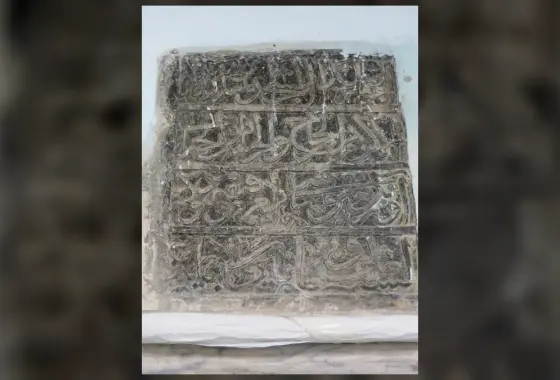
The origins of the Germiyanids are debated; they are thought to have been a Turkmen group that migrated west from the Malatya area in the 13th century. Settled on the frontier by the Seljuks of Rum, the Germiyanids founded a powerful principality centred on Kütahya under Yakub I, with many smaller beys around them as vassals.
Marriage ties with the Ottomans
In 1381 the Germiyanid bey Süleyman Şah married his daughter Devlet Hatun to the Ottoman prince Bayezid. Places such as Kütahya, Simav, Emet and Tavşanlı were given to the Ottomans as her dowry. This marriage produced the future Mehmed I.
Timur and the last years
Bayezid I annexed the principality completely, but after the Battle of Ankara in 1402 Timur returned the Germiyanid lands to Yakub II. Yakub kept good relations with the Ottomans and, being childless, bequeathed his country to Murad II. On his death in 1429 the Germiyanid lands joined the Ottoman state.
Culture
The Germiyanid court was one of the important centres of Turkish literature in Anatolia. Ahmedi’s Iskendername and Sheyhi’s Hüsrev ü Şirin are major works written in this circle. The Vacidiye Madrasa in Kütahya (1314) is known to have been used for teaching astronomy.
Founding and geographical position
The Germiyanids gained strength in and around Kütahya at the end of the 13th century, as the Anatolian Seljuk state began to weaken. Kütahya lies in the interior of western Anatolia, at a point where roads opening to the Aegean coast and the Marmara basin meet. This position gave the Germiyan beys access to revenue from farming and herding as well as a share of trade routes. The borders of the beylik changed over time; besides Kütahya, settlements such as Uşak, Simav, Emet and Tavşanlı are mentioned as under Germiyanid rule.
Being settled in the Seljuk frontier zone obliged the Germiyanids to maintain intensive relations with neighbouring beyliks. To the west lay Aegean beyliks such as the Aydınids and Saruhanids, and to the northwest the rising Ottoman principality. According to some sources, many of these small beyliks were initially linked to the Germiyanid sphere of influence, which is why the Germiyanids are counted among the first major centres of the western Anatolian beylik world. Because sources differ on exact dates and borders, historians use cautious language when describing this period.
Administration, economy and society
Like other Turkmen beyliks of the period, Germiyanid administration rested on a military-political order built around the bey and his commanders. Around the bey stood emirs, judges and endowment officials, while Turkmen tribes in rural areas were tied to the beylik through military service and taxes. Kütahya was the administrative centre of this order, and urban life was strengthened by the founding of madrasas, mosques and markets in the city.
Economically, the region’s value came not only from farming and herding. The Kütahya area is also noted for its mines, particularly silver and other minerals, and weaving and crafts supported the urban economy. Although Kütahya’s tile and ceramic tradition became famous in later centuries under the Ottomans, the roots of the city’s artisan identity reach back to these early periods. Endowments financed both educational institutions and social assistance. Buildings such as the Vâcidiye Madrasa are lasting examples showing that the beylik supported learning and education. Even so, the documents we have on taxes, population and revenue for this period are limited, so interpretations of the economy mostly remain at a general level.
Literature, legacy and assessment
The Germiyanid court opened its doors to poets at a time when Turkish was gaining strength as a written language. Ahmedî wrote his great work, the İskendernâme, in this milieu, while Şeyhî is known for his rendering of Hüsrev ü Şîrîn and his verse works. By conveying products of Persian literature into Turkish, these poets contributed to the development of Anatolian Turkish as a literary language. This activity around the Germiyanids is counted among the forerunners of the Turkish literary tradition that continued later at the Ottoman court.
The political legacy of the Germiyanids passed to the Ottomans by a different route. Unlike most other beyliks of the time, which were annexed by war or pressure, a significant part of the Germiyanid lands joined the Ottoman state through marriage and bequest. This shows that relations among Anatolian beyliks were not only conflict; kinship and diplomacy also played an important role. Historians regard the Germiyanids as an important link both in Turkish political organisation in western Anatolia and in early Anatolian Turkish literature. Still, since our information on the beylik’s internal order often rests on sources written in later periods, it may be updated as new documents and archaeological data emerge.
Limits of the sources and disputed points
A significant part of our information about the Germiyanids rests on Ottoman chronicles written long after the events and on a limited number of endowment documents and inscriptions. Researchers still disagree about the founding date of the beylik, the identities of the first beys and where exactly its borders lay. The origin of the word Germiyan is also debated; some researchers link the name to the form “Kermiyan” and point to the community’s past around Malatya. These interpretations, however, have not been settled definitively.
The question of lands passing to the Ottomans through marriage must also be read carefully. Because the dowry and bequest narratives appear mostly in Ottoman sources, we cannot fully know how the Germiyanid side saw this process. Readers should therefore not take the account of a single source as the final truth, should compare different works, and should bear in mind that new documents may emerge. For historiography this is a general feature of research on Anatolian beyliks: the scarcity of written sources makes caution in interpretation necessary.
Where do we see the Germiyanid legacy today?
Traces of the Germiyanid period can be seen today especially in Kütahya. The Vâcidiye Madrasa in the city is cited as a concrete example of the educational tradition of the beylik period; the surrounding mosques, tombs and fountains are also valuable sources for those who want to follow the development of Anatolian Turkish architecture. Kütahya’s tile and ceramic tradition became famous in later centuries, and the city is still associated with this craft today. The works of Ahmedî and Şeyhî are also among the basic texts for researchers who want to study the maturing of Turkish as a literary language. For this reason the Germiyanids are an important stop not only in political history but also in the history of culture and language.
Sources and further reading
- Türkiye Diyanet Vakfı İslâm Ansiklopedisi, “Germiyanoğulları”.
- İsmail Hakkı Uzunçarşılı, Anadolu Beylikleri ve Akkoyunlu, Karakoyunlu Devletleri.
- Encyclopaedia Britannica, “Germiyan”.
- Türkiye Diyanet Foundation Encyclopaedia of Islam – “Germiyanoğulları” entry
- Encyclopaedia Britannica – Germiyan
- Halil İnalcık – The Ottoman Empire: The Classical Age
- Türkiye Diyanet Foundation Encyclopaedia of Islam – “Germiyanoğulları” entry
- Encyclopaedia Britannica – Germiyan
People also ask
What was the Germiyanids? The Germiyanids were a Turkmen principality founded with Kütahya as its centre at the end of the 13th century, one of the strongest in western Anatolia.
When was the Germiyanids founded? Founded: c. 1300, Kütahya.
When did the Germiyanids end? End: 1429, annexed to the Ottomans by the will of Yakub II.





Leave a comment
Your email address will not be published. Required fields are marked *