



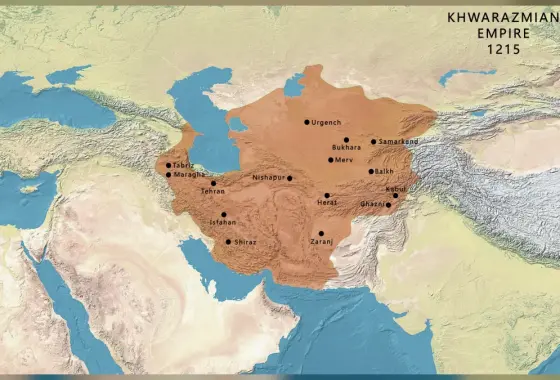
Khwarazm is the fertile region where the Amu Darya flows into the Aral Sea. Under the Great Seljuk sultan Malik-Shah, Anushtegin, a court official of Turkic origin, was made its governor. His descendants ruled the region with the title “Khwarazmshah”.
Towards independence
Atsiz (1127–1156) rebelled several times against Sultan Sanjar in a struggle for independence. Under Tekish (1172–1200) the Khwarazmshahs took Khurasan, and in 1194 defeated the last Seljuk sultan of Iraq, Tughril III, becoming masters of Iran.
Ala al-Din Muhammad
Tekish’s son Ala al-Din Muhammad defeated the Ghurids and the Qara Khitai, adding Transoxiana, Afghanistan and most of Iran to his lands. But in 1218 the killing of a merchant caravan sent by Genghis Khan at the frontier city of Otrar, followed by the mistreatment of his envoys, led to a great war.
The Mongol invasion and the end
In the Mongol assault that began in 1219, Bukhara, Samarkand and the capital Gurganj fell amid great destruction. Ala al-Din Muhammad fled to an island in the Caspian Sea and died there. His son Jalal al-Din fought the Mongols and neighbouring states for a decade; he was defeated by the Seljuks of Rum at Yassıçemen in 1230 and died in 1231.
The state's internal structure and army
The Khwarazmshahs' army was made up largely of Kipchak and Qangli Turks. Terken Khatun, Tekish's wife and the mother of Ala al-Din Muhammad, represented this Qangli circle and held a power at court that could almost be called independent of the sultan. The sources relate that Terken Khatun had her own chancery and decrees, and that her orders competed with the sultan's. This dual structure made it hard to command the army from a single centre when the Mongol threat grew; because Muhammad did not trust his commanders, he preferred to scatter his army among the cities.
Conflict with the Abbasid caliph
Ala al-Din Muhammad entered a fierce rivalry with the Abbasid Caliph al-Nasir li-Din Allah. He suspected the caliph of cooperating with the Ghurids and other powers against the Khwarazmshahs. In 1217 he marched on Baghdad and attempted to have another caliph proclaimed in his own name; however, his army suffered heavy losses from deep snow and cold in the Zagros Mountains, and the campaign was abandoned. This failure shook the state's prestige and strength just before the Mongol invasion.
What happened in the Otrar incident?
In 1218 a merchant caravan sent by Genghis Khan, said in the sources to number about four hundred and fifty people, reached Otrar. The city's governor, Inalchuq (Ghayir Khan), accused the merchants of spying, had them killed and seized their goods. Genghis Khan sent envoys to demand compensation and the surrender of the governor; one envoy was killed and the others were sent back with their beards shaved. Historians such as Juvayni and Rashid al-Din present this incident as the direct cause of the Mongol campaign.
Gurganj and the legacy of Khwarazm
The remains of Gurganj, the Khwarazmshah capital, lie today at Kunya-Urgench in Turkmenistan and were added to the UNESCO World Heritage List in 2005. A mausoleum attributed to Tekish stands there, along with the Kutlug Timur minaret from a later period. In the Khwarazmshah era, figures such as the renowned scholar Fakhr al-Din al-Razi enjoyed the patronage of this court. Despite the Mongol destruction, the region became an important trading centre again in the Golden Horde period.
The last stand on the banks of the Indus
Ala al-Din Muhammad's son Jalal al-Din continued resistance against the Mongols in Afghanistan after his father's death. In 1221 he met Genghis Khan's army on the banks of the Indus River and was defeated. According to the sources, he escaped by leaping with his horse from a high bank into the river and swimming to the other side. Juvayni relates that Genghis Khan, impressed by this courage, held him up as an example to his own sons. After staying in India for a time, Jalal al-Din returned to Iran.
Sources and further reading
- Türkiye Diyanet Vakfı İslâm Ansiklopedisi, “Hârizmşahlar”.
- Juvayni, Tarikh-i Jahangushay.
- Encyclopaedia Britannica, “Khwarezm-Shah dynasty”.
- UNESCO World Heritage Centre – Kunya-Urgench, inscribed 2005
- V. V. Barthold – Turkestan Down to the Mongol Invasion
People also ask
What was the Khwarazmshahs? The Khwarazmian state was founded by a dynasty descended from Anushtegin, a man of Turkic origin appointed to Khwarazm by the Seljuks.
When was the Khwarazmshahs founded? Founded: c. 1077, governorship of Anushtegin.
What was the Khwarazmshahs’s capital? Capital: Gurganj (Urgench).
When was the Khwarazmshahs at its height? Height: Reign of Ala al-Din Muhammad (1200 – 1220).


Leave a comment
Your email address will not be published. Required fields are marked *