



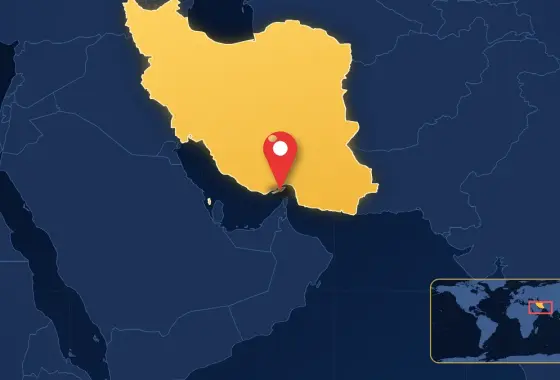
Iran and the United States have again exchanged strikes at a time when mediators are still holding talks. According to CBS News and Al Jazeera, Iran’s Islamic Revolutionary Guard Corps (IRGC) said on Tuesday, 17 November, that its drones had hit a US radar system at an air base in Bahrain. US Central Command (CENTCOM) called the claim “FALSE”, saying the incoming drones were intercepted and that there was no damage to US equipment and no injury to personnel.
Later the same day, a US military official said the United States had carried out “precision strikes” on an IRGC missile site on Qeshm Island in the Strait of Hormuz. The official described the strike as “self-defense” in response to “IRGC aggression targeting U.S. personnel and assets”. ABC News reported that launchers were the target. An official from Hormozgan province, speaking to Iran’s official news agency IRNA, said the strike caused no damage to residential, commercial or infrastructure facilities on the island.
What happened in Bahrain?
According to CBS News, the IRGC claimed its drones hit a radar at Sheikh Isa Air Base, which is used by US forces. Bahrain’s military said Iranian attacks were intercepted before reaching their targets. This was the third attempted Iranian attack on US military installations in the Gulf in five days; US officials said all three were intercepted.
According to Al Jazeera’s overview, the first claim came on Friday, 13 November: the IRGC said it had “destroyed” a US early-warning radar in Bahrain in retaliation for an air strike on a telecommunications tower in southern Iran, while CENTCOM said it shot down two drones and reported no damage. Reuters said this was Iran’s first claim of an attack on US military assets in a Gulf country since early September. On Sunday, 15 November, the IRGC said it had sent six drones at an air defence radar at Riffa Air Base; Bahrain’s Interior Ministry issued two alerts within about three hours, urging residents to take shelter.
The capital, Manama, hosts the US Navy’s Fifth Fleet. That is why Bahrain is among the countries most directly exposed whenever US-Iran tensions escalate. A Pentagon Inspector General report released in September found that during the first four months of the war Iranian attacks damaged or destroyed buildings at US installations in eight countries, including Bahrain.
What else happened in the region?
On the same day, Kuwait’s military reported “hostile drone attacks” and said the explosions heard were air defences intercepting them; no one claimed responsibility. The Saudi-led coalition said it shot down a Houthi drone near Riyadh, the fourth consecutive day of Houthi drone attacks. The Houthis claimed to have targeted pumping stations on Saudi Arabia’s East-West pipeline.
Uncertainty also persists in the Strait of Hormuz. The IRGC and Iran’s navy claimed that some tankers hit sea mines near the strait; CBS News noted that Iran has made similar claims for weeks without evidence, while CENTCOM has said the southern shipping lanes have been cleared of mines and are safe. Meanwhile, Iraq was reported to have resumed pumping oil to Türkiye at 120,000 barrels per day, with plans to raise the flow to 500,000 barrels per day; this development also matters for Türkiye as an alternative export route to Hormuz.
Where does mediation stand?
Qatar said mediation between the United States and Iran is continuing, but warned that escalation poses an “extremely grave danger” to reaching a deal and called on both sides to show restraint. Iranian Foreign Minister Abbas Araghchi met Oman’s foreign minister in Muscat to discuss options for easing tensions. According to Al Jazeera, Iran has sent seven conditions through a Qatari mediator and is awaiting an official US response; they include lifting the US naval blockade and sanctions, releasing frozen Iranian funds, ending hostilities on all fronts and formally declaring the war over. Washington, for its part, has tightened sanctions and is maintaining the blockade of Iranian ports.
Iran’s deputy foreign minister said inspections of damaged nuclear sites would not be allowed until the war has “permanently ended”. The White House, responding to a CNN report that Iran had prepared a “dirty bomb” plot against Washington, said there were no credible threats to the homeland; Iranian officials dismissed the report as baseless.
Why are oil prices being watched?
Since the war began on 28 February, uncertainty in the Strait of Hormuz has been the main risk factor for energy markets. According to CBS News, Brent crude stood at $95.34 a barrel on 16 November, well above the roughly $72 level before the war. If the new exchanges make talks on reopening the strait harder, pressure on prices could persist. Analyst Saeid Golkar told Al Jazeera that limited tit-for-tat attacks could escalate into a wider war through miscalculation.
What does this mean?
The return of attack claims against US targets after a relatively quiet period of about two months shows how fragile the diplomacy around a ceasefire and the reopening of the strait remains. The two sides’ accounts also contradict each other: Iran says it hit the radar, while the US says all drones were intercepted. Because the attacks are hard to verify independently, the outcome of talks through the Qatari and Omani channels in the coming days will be decisive for the security of Gulf states and for oil prices. For Türkiye, both energy costs and the alternative oil flow arriving via Iraq are issues to watch closely.
This report was compiled as of 18 November 2026, 09:00 Türkiye time; follow developments as they are updated.
Frequently asked questions
What did Iran target in Bahrain?
The Revolutionary Guards said their drones hit a US radar system at an air base in Bahrain; the US said the drones were intercepted and there was no damage.
How did the US respond?
The US struck an IRGC missile site on Qeshm Island in the Strait of Hormuz, citing “self-defense”.
Are talks still going on?
Qatar said mediation is continuing; Iran’s foreign minister met Oman’s foreign minister in Muscat.
Sources and further reading
- CBS News, “Iran war live updates: U.S. launches strikes on Iran’s Qeshm Island in Strait of Hormuz”, 17 November 2026.
- Al Jazeera, “Iran says it targets US radar in Bahrain. What do we know?”, 15 November 2026.
- ABC News, “Iran live updates: US conducts airstrikes on Qeshm Island, US military official says”, 17 November 2026.



Leave a comment
Your email address will not be published. Required fields are marked *