



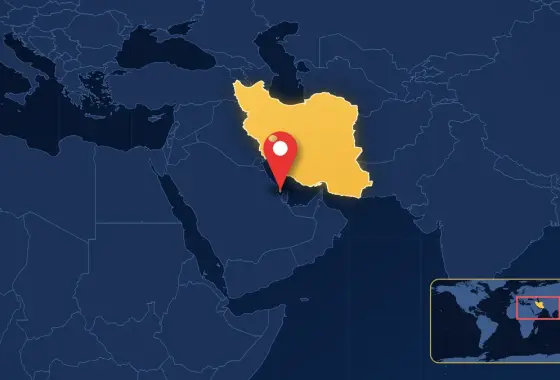
Iran’s Revolutionary Guards announced on Saturday, 21 November 2026, that they had attacked US air defence radar systems at two bases in Bahrain. Al Jazeera’s live page reports that the Guards targeted radars at the al-Rafa (Riffa) and Awali air bases, while Bahraini authorities said an industrial facility was hit and condemned the attacks. The same day Iranian Foreign Minister Abbas Araghchi said reopening the Strait of Hormuz was not difficult but depended on Washington accepting Iran’s conditions.
This report is based on the accounts of Al Jazeera and Anadolu Agency of 21–22 November. The Guards’ statements are claims by the Iranian side; where there is no independent verification, this is stated. Nothing here is presented as a separately verified fact.
What happened in Bahrain?
According to Al Jazeera’s summary, the Revolutionary Guards said they struck US air defence radar systems at Bahrain’s al-Rafa and Awali air bases. Anadolu Agency’s morning briefing relays the same claim in slightly different terms: the Guards claimed they destroyed two US Patriot radars at Riffa and Awali in missile and drone attacks. Bahrain renewed its threat alert. The two sources spell the place name differently (al-Rafa and Riffa), reflecting different transliterations of the Arabic name.
What did Bahrain’s authorities say?
Bahraini authorities said an industrial facility was hit and condemned the attacks. Al Jazeera links to a separate report about a fire at an industrial facility, but the extent of the fire, the name of the facility and whether anyone was hurt are not confirmed in the readable text. This report therefore gives no figure for the damage. The gap between the targets Iran claims and the damage Bahrain confirmed is a point that will need to be clarified later.
Araghchi’s statement
According to Anadolu Agency, Araghchi told a ceremony marking Oman’s National Day that reopening the Strait of Hormuz was not difficult and that the United States only needed to accept what he called Iran’s reasonable conditions, in line with international law. He added that the strait would remain closed until those conditions were met, that the issue could be resolved only if Washington acknowledged its mistakes and fulfilled earlier commitments, and that reopening was not on the agenda while Iran’s demands went unmet.
The claim that the blockade is illegal
Araghchi described the US blockade of Iran as “completely illegal” and said he hoped for a rational way to lift it. He said Iran was ready for talks, just as it was ready to defend itself. His remarks fit the broader picture of Iran pursuing diplomacy and military pressure at the same time, but the statement does not spell out which conditions are meant. That vagueness makes it difficult to assess the substance of any negotiation from the outside.
The Qatari delegation and consultations with Oman
According to Iranian Deputy Foreign Minister Kazem Gharibabadi, a Qatari delegation arrived in Tehran on Friday evening and held about two hours of talks; discussions with Qatar continue online and in person. Qatar had not commented. Araghchi said such visits were routine and that mediators regularly travel to relay ideas and proposals. He said he met Oman’s sultan and foreign minister four days earlier and that consultations would go on. Two small but influential Gulf actors thus stand out as channels between the sides.
Trump’s pledge of a permanent deal
According to Anadolu Agency’s morning briefing, US President Donald Trump said on Saturday that he intends to secure a “permanent” deal with Iran and that no future US president should be able to let Tehran obtain a nuclear weapon. He said that even if an “incompetent” president took office in four, fifteen or twenty years, the agreement he reaches would be permanent. There are no details about the content or timetable of an agreement; the remark is recorded as a statement of intent, not as verifiable progress in talks.
Other developments: the F-16 claim and the Houthis
According to Anadolu Agency, Iran’s army claimed that an air defence missile exploded near a US F-16 over the Gulf, damaging it and forcing an emergency landing. US Central Command (CENTCOM) rejected the claim, saying all US fighter aircraft in the Middle East were safe and accounted for. Al Jazeera reports that Houthi spokesman Yahya Saree said there was no threat to Mecca; Saudi Arabia had issued a danger alert for Mecca province and lifted it moments later. Houthi strikes continued for another night.
The Saudi-led coalition and Türkiye’s position
According to Anadolu Agency, the Saudi-led coalition intercepted and destroyed a Houthi ballistic missile fired toward western Saudi Arabia, and Saudi Civil Defense had issued a danger alert for the Mecca region. Foreign Minister Hakan Fidan said Türkiye, a member of the Mecca Defense Alliance with Saudi Arabia and Pakistan, prioritises defending Saudi Arabia. He said no decision had been made on sending troops to Yemen and that a possible US–Iran agreement carried “critical weight” for easing global economic strain beyond simply reopening Hormuz.
Why is the Strait of Hormuz so important?
The Strait of Hormuz is a narrow waterway linking the Persian Gulf with the Gulf of Oman and the open sea. Because a significant share of world oil and liquefied natural gas trade passes through it, any disruption feeds into global prices through freight and insurance costs. This is general background; the sources give no tonnage or share. According to a background note in the ANews report, Iran moved to close the strait again on 12 July, four days after the United States resumed attacks on the country.
Obstacles facing mediation
Read together, Araghchi’s two messages say that Iran is ready for talks but that the strait will not open until its conditions are met. The US side voices a wish for a permanent deal without responding to the content of Iran’s conditions. The sources do not say what concessions are possible between those positions. Because the content of the proposals carried by mediators has not been disclosed, it is not possible from the outside to say whether there is progress; only that the channels are open.
The call on Gaza
In the same speech Araghchi said he had asked for an emergency meeting of foreign ministers of the Organisation of Islamic Cooperation (OIC) on Gaza and called the situation “a kind of silent genocide.” That wording is Araghchi’s and is reported here only as his statement. Iran’s tendency to link regional crises raises the question of whether the Hormuz negotiation will be handled together with files such as Gaza and Lebanon; the sources give no information on this.
Regional implications
Bahrain’s renewed threat alert shows that the US presence in the Gulf is both a target for Tehran and a security concern for host countries. The brief alert in the Mecca region over Houthi strikes also points to a conflict reaching the Red Sea and the Arabian Peninsula. These are general readings drawn from the events the sources report; most claims rest on the parties’ own statements and have not been independently confirmed.
What should be watched?
Several points deserve attention in the coming days: whether the damage and any casualties in Bahrain are officially disclosed, how the United States responds to the radar claim, whether a concrete proposal emerges from the Qatari and Omani channels, whether the OIC holds an emergency meeting on Gaza, and how intense Houthi attacks on Saudi Arabia remain. These are follow-up points consistent with the sources and may change as events develop.
What does this mean?
In the short term, the events show military tension and diplomatic contact continuing in the Gulf at the same time. In the medium term, the reopening of Hormuz appears to depend on the sides agreeing on conditions, but since neither has openly given ground, the timing is unclear. These readings rest on information relayed by the sources and are not firm forecasts.
This report was compiled as of 22 November 2026, 09:00 Türkiye time; figures and details may differ between sources and should be followed as developments are updated.
Frequently asked questions
What did the Revolutionary Guards claim?
That they struck US air defence radars at Bahrain’s Riffa (al-Rafa) and Awali bases; Anadolu says they claimed to have destroyed two Patriot radars. The claim has not been independently verified.
What did Bahrain say?
It said an industrial facility was hit, condemned the attacks and renewed its threat alert.
What did Araghchi say about Hormuz?
That reopening is not difficult but the strait stays closed until the United States accepts Iran’s conditions.
How did CENTCOM respond to the F-16 claim?
It said all US fighter aircraft in the Middle East were safe and accounted for.
Sources and further reading
- Al Jazeera, “Iran war live: Iran targets US military in Bahrain; Houthi strikes continue”, 21 November 2026.
- Anadolu Agency, “Iran says reopening Hormuz ‘not difficult’ if US accepts Tehran’s conditions” (ANews), 21 November 2026.
- Anadolu Agency, “Morning Briefing: Nov. 22, 2026”, 22 November 2026.

Leave a comment
Your email address will not be published. Required fields are marked *