



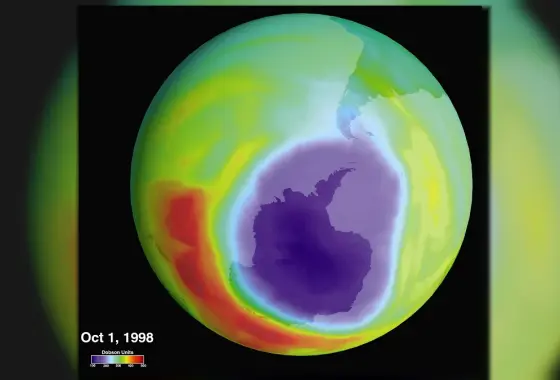
The ozone layer is a natural shield in the stratosphere, about 15–35 kilometres above the ground, where ozone gas is concentrated and filters out most of the harmful ultraviolet (UV-B) radiation from the Sun. For those asking “what does the ozone layer do?” or “has the ozone hole closed?”, the good news is that thanks to international cooperation the layer is slowly but steadily recovering.
Why is the ozone layer important?
Ozone (O₃) is a molecule made of three oxygen atoms. Ozone in the stratosphere absorbs UV-B rays, which raise the risk of skin cancer and cataracts and harm plants and marine life. Without the ozone layer, life on land as we know it would not be possible. (Ozone at ground level, by contrast, is part of air pollution and harmful to breathe.)
How was the ozone hole discovered?
In 1985 scientists from the British Antarctic Survey reported that the amount of ozone over Antarctica fell dramatically every spring. This thinning became known as the “ozone hole”. The culprits turned out to be man-made chemicals such as chlorofluorocarbons (CFCs) used in refrigerators, air conditioners and aerosol cans. When these gases reach the stratosphere they are broken apart by sunlight, and the chlorine released destroys ozone molecules in a chain reaction. Mario Molina, Sherwood Rowland and Paul Crutzen, who predicted the effect of CFCs on ozone, received the 1995 Nobel Prize in Chemistry.
What is the Montreal Protocol?
Signed in 1987, the Montreal Protocol is the international agreement that phased out the production and use of ozone-depleting substances. The first treaty ratified by every UN member state, it has eliminated about 99% of ozone-depleting substances and is widely cited as one of the most successful environmental agreements in history.
Is the ozone layer healing?
Yes. According to the 2023 scientific assessment by the World Meteorological Organization and the UN Environment Programme, if current policies remain in place the ozone layer is expected to return to 1980 levels around 2066 over Antarctica, around 2045 over the Arctic and around 2040 for the rest of the world. Although the size of the ozone hole varies from year to year with weather conditions, the overall trend is towards recovery.
Frequently asked questions
Does the ozone hole cause climate change?
They are different problems: the ozone hole is about UV radiation, climate change about greenhouse gases. There is a link, though: CFCs are also powerful greenhouse gases, so the Montreal Protocol has also helped slow climate change.
Does the ozone layer protect us completely from the Sun?
No. Some UV radiation still reaches the ground, so sunscreen, a hat and sunglasses remain important.
Sources
- WMO/UNEP, “Scientific Assessment of Ozone Depletion: 2023”.
- UN Environment Programme (UNEP) Ozone Secretariat, the Montreal Protocol.
- Farman, Gardiner, Shanklin, Nature, 1985.
- Nobel Foundation, 1995 Nobel Prize in Chemistry.






Leave a comment
Your email address will not be published. Required fields are marked *