



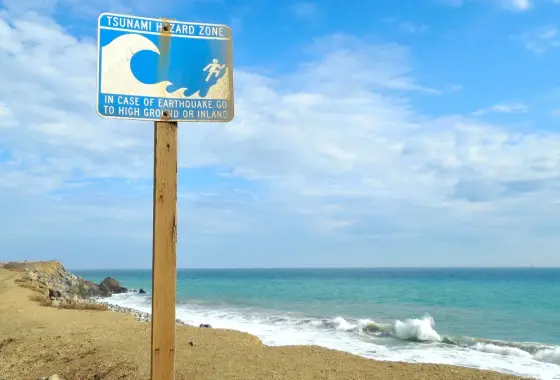
A tsunami is a series of waves created when the sea floor or a body of water is suddenly displaced, reaching the coast with enormous force. For those asking “how does a tsunami form?” or “what does tsunami mean?”, in short: the word is Japanese for “harbour wave”, and the most common cause is a large earthquake under the sea.
How does a tsunami form?
- Undersea earthquakes: especially where one tectonic plate dives beneath another, the sea floor along the fault suddenly rises or drops, moving the water above it.
- Underwater landslides: large slides on the continental slope can push water and generate a tsunami.
- Volcanic eruptions: events such as the 1883 eruption of Krakatoa have caused devastating tsunamis.
- Meteorite impacts: very rare but possible.
How fast does a tsunami travel?
In the deep ocean a tsunami can travel as fast as a jet plane, up to 700–800 kilometres per hour, but there it is often less than a metre high and ships may not notice it. As it nears the coast the water becomes shallower, the wave slows and its energy piles up, so its height can reach tens of metres. A tsunami is not a single wave but a series arriving minutes or hours apart, and the first wave is not always the largest.
What are the warning signs of a tsunami?
- A strong earthquake felt on the coast that lasts a long time or makes it hard to stand.
- The sea retreating unusually fast, exposing the sea floor.
- A loud roar from the sea, like a jet engine or a train.
What should you do in a tsunami?
- If you are on the coast and feel a strong earthquake, move to high ground or inland immediately, without waiting for an official warning.
- If the sea retreats, never go towards the shore; it means a wave is coming.
- Evacuate on foot if possible; car traffic can block roads.
- If there is no high ground, go to the upper floors of a sturdy multi-storey building.
- Do not return to the coast until officials say it is safe; later waves can be bigger.
The biggest tsunamis in history
On 26 December 2004, a magnitude 9.1 earthquake off Indonesia triggered a tsunami that killed more than 225,000 people in 14 countries around the Indian Ocean. On 11 March 2011, the tsunami after Japan’s magnitude 9.0 Tōhoku earthquake killed about 18,000 people and caused the Fukushima nuclear accident.
Frequently asked questions
Does every undersea earthquake cause a tsunami?
No. A tsunami usually needs a large (around magnitude 7 or more), shallow earthquake that moves the sea floor vertically.
Which coasts are at risk of tsunamis?
The Pacific “Ring of Fire” is most at risk, but the Indian Ocean, the Mediterranean and the Caribbean also have tsunami records. On any coast, the rule is the same: after a strong earthquake, go to high ground.
Sources
- US National Oceanic and Atmospheric Administration (NOAA), “Tsunami Safety” and “How do tsunamis form?”.
- UNESCO Intergovernmental Oceanographic Commission (IOC), tsunami education materials.
- US Geological Survey (USGS), the 2004 Sumatra and 2011 Tōhoku earthquakes.





Leave a comment
Your email address will not be published. Required fields are marked *