



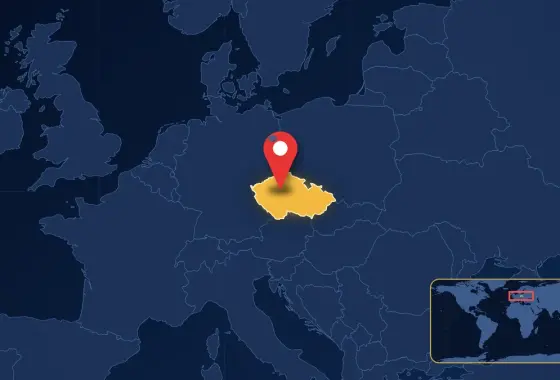
On the morning of Tuesday, 17 November, two regional passenger trains collided head-on very close to the main railway station (Praha hlavní nádraží) in Prague, the Czech capital. According to Prague’s emergency medical service, 46 people were injured: four seriously, 12 moderately and 30 lightly. The seriously injured include the drivers of both trains. As reported by Euronews and Prague Daily, 16 of the injured are foreign nationals, including citizens of Slovakia, Ukraine, Russia, Nigeria and Bulgaria. No one was killed.
The collision happened at around 07:20 local time on the railway bridge over Seifertova Street in the Prague 3 district. One train was heading towards Milovice, while the other was coming from Mladá Boleslav. According to reports, both trains were braking and collided at low speed; even so, footage shared by police shows the front sections of the two trains crumpled into each other.
How did the rescue operation unfold?
According to the emergency medical service, the first crew reached the scene within four minutes of the call. More than 10 ambulance crews, four crews with a doctor, an inspector and a special vehicle for mass evacuation were sent to the area. Seriously and moderately injured people were taken to hospitals as a priority, and a crisis intervention team provided psychological support to passengers and their relatives. Medical teams said work at the scene was completed at 09:40 local time.
The crash happened at one of Prague’s busiest railway junctions during the morning commute. As a result, services from the main station towards Vysočany and Libeň were suspended. The interlocked trains were separated at around 11:30, and traffic at the main station resumed without restrictions around midday, about six hours after the crash. According to Prague Daily, initial estimates put the material damage at more than 16 million Czech korunas (about 650,000 euros).
What could have caused the crash?
Findings so far indicate that one of the two trains passed a signal showing “stop”. It is not yet clear whether this was caused by a technical fault or human error. Transport Minister Ivan Bednárik described the crash as a “serious incident”, thanked medical and fire crews for their “professional and swift response” and said an investigation had been launched. In the Czech Republic, railway accidents are investigated independently by the Rail Safety Inspection Office (Drážní inspekce); the exact cause will become clear once signal records and the drivers’ statements have been examined.
According to Prague Daily, the central railway safety system issued a general “stop” command just before the crash but could not prevent the collision. The Commission for Improving Railway Safety at the Transport Ministry is expected to hold an extraordinary meeting this week to assess the accident and possible additional measures. The operator, Czech Railways (České dráhy), announced that it will compensate affected passengers.
What is ETCS and why is it being discussed?
After the crash, the most discussed topic has been the European Train Control System (ETCS). ETCS is part of the European Union’s common railway signalling standard. The system continuously monitors a train’s permitted speed and the point where it must stop; if the driver misses a signal or exceeds the speed limit, it brakes the train automatically. That is why it is seen as one of the most effective tools for preventing accidents of the “signal passed at danger” type.
However, the tracks at Prague’s main station do not yet have ETCS. Tomáš Tóth, Director General of the infrastructure manager Správa železnic, said the system is planned to go live on this section in 2029. The Czech Republic is gradually moving its main lines to ETCS, but busy station areas, with their complex arrangements of points and signals, are usually among the last places to be equipped.
Have there been similar accidents in the Czech Republic?
The Czech Republic has one of the densest railway networks in Europe, and several serious accidents in recent years have put rail safety on the national agenda. One of the worst happened near Pardubice in June 2024, when four people were killed in a collision between a passenger train and a freight train. After that accident, calls to expand signalling and automatic braking systems also grew louder. The latest crash in Prague has brought the same debate to the busiest point in the capital.
What does this mean?
The low speed of the collision and the arrival of rescue teams within minutes were decisive in preventing deaths. Even so, 46 injuries show how serious the consequences of a single signal error can be in a busy station area. In the coming days, the outcome of the investigation and the commission’s decisions will determine whether the ETCS installation timetable is brought forward. For passengers travelling to or living in Prague, train traffic has returned to normal; however, for compensation and service information, Czech Railways’ official announcements should be followed.
This report was compiled as of 18 November 2026, 19:00 Türkiye time; follow developments as they are updated.
Frequently asked questions
How many people were injured in the Prague train crash?
According to Prague’s emergency medical service, 46 people were injured: four seriously, 12 moderately and 30 lightly. No one was killed.
What caused the crash?
Preliminary findings show that one of the trains passed a signal showing “stop”; investigators are examining whether this was due to a technical fault or human error.
Have train services returned to normal?
Yes. The trains were separated at around 11:30, and traffic at the main station resumed without restrictions about six hours after the crash.
Sources and further reading
- Euronews, “46 people injured after two trains collide in Prague”, 17 November 2026.
- Prague Daily, “Head-on Collision Between Two Passenger Trains in Prague: 46 Injured, Four Seriously”, 18 November 2026.
- Anadolu Agency, “Morning Briefing: Nov. 18, 2026”, 18 November 2026.

Leave a comment
Your email address will not be published. Required fields are marked *