



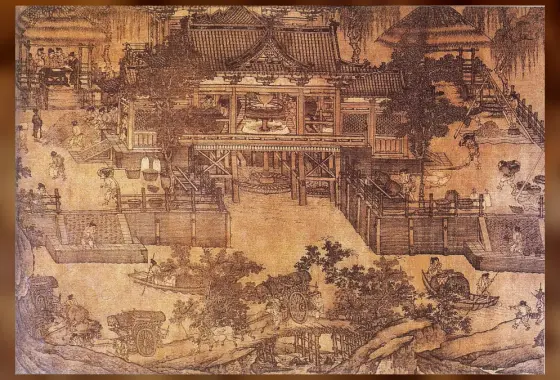
After the period of division that followed the fall of the Tang dynasty, the general Zhao Kuangyin seized the throne in 960 and founded the Song dynasty, with its capital at Kaifeng. The Song rulers curbed the power of military governors and built a government based on civil officials selected by examination.
Northern and Southern Song
In the north the Song contended with the Khitan Liao and the Tangut Western Xia. In 1127 the Jin state founded by the Jurchens took Kaifeng and captured the emperor. A surviving branch of the dynasty withdrew south and moved its capital to Lin’an (today’s Hangzhou); this era is known as the “Southern Song”.
Science and economy
The Song era was one of the most innovative in Chinese history. Movable-type printing, developed by Bi Sheng in the 11th century, the use of the compass at sea and gunpowder weapons all appeared in this period. The world’s first state-issued paper money was used, and maritime trade and cities grew. The Neo-Confucianism developed by Zhu Xi shaped East Asian thought for centuries.
The Mongol conquest
In the 13th century the Mongols first destroyed the Jin (1234) and then turned on the Southern Song. After long sieges Kublai Khan’s armies took Hangzhou in 1276. At the Battle of Yamen in 1279 the last Song resistance collapsed and China passed under the Mongol Yuan dynasty.
Sources and further reading
- Encyclopaedia Britannica, “Song dynasty”.
- Dieter Kuhn, The Age of Confucian Rule: The Song Transformation of China, Harvard University Press.
- Joseph Needham, Science and Civilisation in China, Cambridge University Press.
People also ask
What was the Song Dynasty? The Song dynasty ruled China from 960 to 1279.
What was the Song Dynasty’s capital? Capitals: Kaifeng; Lin’an (Hangzhou) after 1127.
When did the Song Dynasty end? End: 1279, Battle of Yamen (Mongols).



Leave a comment
Your email address will not be published. Required fields are marked *