



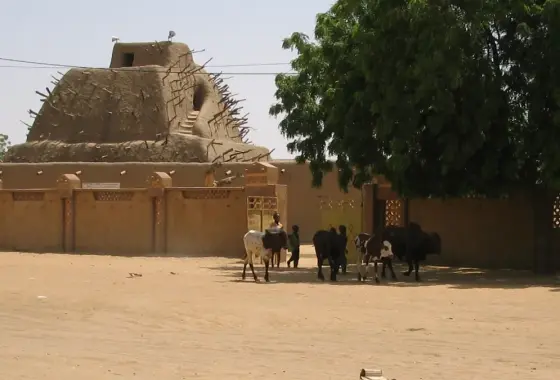
The Songhai were a people living around Gao on the Niger River and were long subject to the Mali Empire. Growing stronger as Mali weakened, Songhai became a great empire under Sonni Ali, who came to power in 1464. Sonni Ali took Timbuktu in 1468 and Djenné around 1473, building a powerful cavalry army and a river fleet.
Askia Muhammad
After Sonni Ali’s death his general Askia Muhammad seized the throne in 1493 and founded the Askia dynasty. On his pilgrimage to Mecca with a large caravan in 1496 – 1497, he was recognised by the Abbasid caliph in Cairo as “caliph of Takrur” (West Africa). He divided the country into provinces, standardised weights and measures and made Islamic law the basis of government.
Timbuktu’s golden age
In this period Timbuktu, with the scholars around the Sankore Mosque and its rich libraries, became one of the important centres of learning in the Islamic world. Trade in gold, salt and books flourished along the trans-Saharan routes. Scholars such as Ahmad Baba were trained in this era.
Tondibi and collapse
In 1591 an army sent by the Moroccan Sultan Ahmad al-Mansur under Judar Pasha, armed with firearms, defeated the Songhai army at the Battle of Tondibi. Gao and Timbuktu passed to Moroccan rule and the empire broke up into small states. The Tomb of Askia in Gao is now a UNESCO World Heritage Site.
Sources and further reading
- Abd al-Rahman al-Sa‘di, Tarikh al-Sudan.
- UNESCO World Heritage, “Tomb of Askia”.
- Encyclopaedia Britannica, “Songhai empire”.
People also ask
What was the Songhai Empire? The Songhai Empire was the largest state in West Africa in the 15th and 16th centuries.
What was the Songhai Empire’s capital? Capital: Gao.
When was the Songhai Empire at its height? Height: Askia Muhammad (1493 – 1528).
When did the Songhai Empire end? End: Battle of Tondibi, 1591.

Leave a comment
Your email address will not be published. Required fields are marked *