



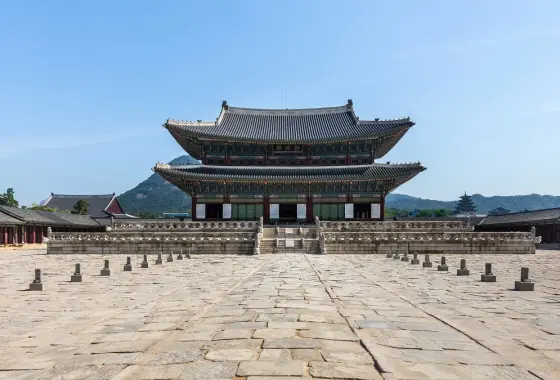
Yi Seong-gye, a general of the Goryeo kingdom, seized the throne in 1392, founding the Joseon dynasty and taking the name King Taejo. The capital moved to Hanseong (today’s Seoul), where Gyeongbokgung Palace was built in 1395. The new state adopted Neo-Confucianism instead of Buddhism as its official ideology, and officials were selected by examination.
Sejong the Great and Hangul
The dynasty’s fourth king, Sejong the Great (1418 – 1450), is known for the “Hall of Worthies” where he gathered scholars. The Hangul alphabet, designed so that ordinary people could easily learn to read and write, was promulgated in 1446 as the “Hunminjeongeum”. Instruments such as rain gauges, sundials and celestial globes were also developed in this period.
The Imjin War
In 1592 Japanese armies under Toyotomi Hideyoshi invaded Korea. Admiral Yi Sun-sin won a string of victories over the Japanese navy with his armoured “turtle ships”, and Ming China sent aid to Joseon. The war ended with the Japanese withdrawal in 1598, but the country was devastated.
The hermit kingdom and the end
After the Manchu invasions of the 17th century Joseon became a tributary of Qing China and largely closed itself to the outside world, earning the Western name “Hermit Kingdom”. The Treaty of Ganghwa with Japan in 1876 forced it to open its ports. In 1897 King Gojong proclaimed the Korean Empire, bringing the Joseon period to an end.
Sources and further reading
- Encyclopaedia Britannica, “Chosŏn dynasty” and “Sejong”.
- Michael J. Seth, A Concise History of Korea, Rowman & Littlefield.
- UNESCO Memory of the World, “Hunminjeongeum Manuscript”.
People also ask
What was the Joseon Dynasty? The Joseon dynasty ruled the Korean Peninsula from 1392 to 1897, the longest-lived dynasty in Korean history.
What was the Joseon Dynasty’s capital? Capital: Hanseong (Seoul).
When did the Joseon Dynasty end? End: 1897, proclamation of the Korean Empire.
Leave a comment
Your email address will not be published. Required fields are marked *