



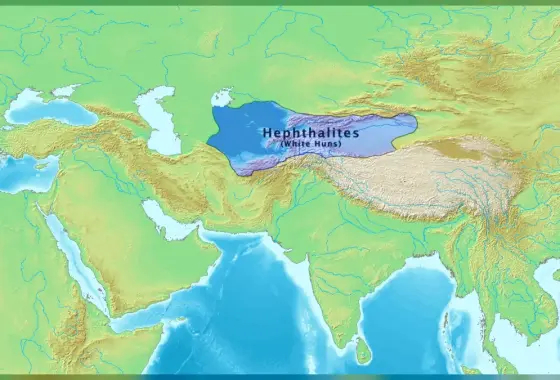
The Hephthalites are called “White Huns” in Byzantine sources and “Heftal” or “Hephthalites” in Sasanian and Islamic sources. In the mid-5th century they grew strong in the Tokharistan region south of the Amu Darya and came to dominate a wide area.
Struggle with the Sasanians
The Hephthalites intervened in the internal affairs of the Sasanian Empire. The Sasanian king Peroz was defeated in his campaigns against them and died in battle in 484, after which the Sasanians paid them tribute for a time. The Sasanian king Kavad I is known to have regained his throne with Hephthalite support.
India and trade
The Hephthalites and related groups advanced into northern India as the Gupta Empire weakened. Controlling an important section of the Silk Road, they drew great revenues from trade. The Byzantine historian Procopius describes them as, unlike other Huns, a settled people governed by laws.
Fall
Istemi Yabgu, who governed the western wing of the Göktürk Khaganate founded in 552, allied with the Sasanian king Khosrow I Anushirvan. Their joint attack destroyed the Hephthalite state around 557–560, and its lands were divided between the Göktürks and the Sasanians.
Origins
Turkish historiography regards the Hephthalites as a continuation of the Hunnic tradition and a Turkic state. International scholarship also includes views that they were of Iranian or mixed origin; the question is debated.
From the Kidarites to the Akhuns: A Shift of Power in Tokharistan
The rise of the Akhuns is linked to the breakdown of an older balance of power in Central Asia and Bactria (Tokharistan). From the late 4th century a dynasty known as the Kidarites bordered both the Sasanians and the Guptas of northern India. After the middle of the 5th century the Akhuns became the dominant force in the Amu Darya basin, taking the place of the Kidarites.
The details of this transition are not fully understood because sources are scarce. None of the Byzantine, Sasanian, Chinese or Indian sources describes the Akhuns first-hand and as a whole, and the state’s own written archive has not survived. Historians therefore try to build a picture by reading the records of neighbouring states together with coins. Whether the names Akhun and Hephthalite refer to the same community or to related but different groups is also among the debated questions.
Capital, Administration and the Bactrian Language
Chinese travellers and envoys are among the rare direct witnesses who describe the Akhun ruler and his seat of government. One of them, Song Yun, writing in the early 6th century while travelling through Central Asia in search of Buddhist scriptures, says he was received by the Akhun ruler in a tent palace. The exact location of the place named as the capital in Chinese sources remains disputed.
In recent years, documents in the Bactrian language from the Rob region of Afghanistan have given valuable information on the daily workings of administrations that followed and overlapped with the Akhuns. Bactrian, written in an alphabet derived from Greek letters, remained the common language of administrative and commercial correspondence in the region. This suggests that a ruling class of nomadic origin governed a settled society by drawing on local traditions of writing and taxation. Coins likewise show designs inspired by Sasanian issues and legends in Bactrian.
The Sasanian Wars: Peroz’s Defeat and Kavad I
The struggle between the Akhuns and the Sasanians occupied Iran’s eastern frontier for a long time in the second half of the 5th century. The Sasanian king Peroz was first captured in his campaigns against the Akhuns and was released only after a heavy ransom was paid. A later campaign launched to take revenge ended in defeat and his death around 484. The sources report that this defeat was very costly for the Sasanian army and the state treasury.
After Peroz’s death the Sasanians had to pay tribute to the Akhuns for a time. The future king Kavad I spent part of his youth at the Akhun court; when he was deposed in 488 he again took refuge with them, and around 498–499 he regained the throne with their military support. These events show that the Akhuns were not only a frontier threat but also a decisive actor in Sasanian domestic politics.
The Campaigns in India: Toramana and Mihirakula
From the late 5th century groups associated with the Akhuns also pressed into northern India. The best-known leaders of this community, called Huna in Indian sources, are Toramana and his son Mihirakula. Whether these names belong to the Akhuns themselves or to a related group called the Alchon is debated among scholars, and coin and inscription evidence is used to try to clarify the distinction.
According to Chinese and Indian texts, Mihirakula’s reign is remembered as destructive for Buddhist monasteries and settlements, but these accounts mostly come from Buddhist or hostile sources and may exaggerate. The generally accepted view today is that Indian rulers broke this pressure in the first half of the 6th century and that Huna attacks contributed to the weakening of the Guptas. Even so, the scale of the damage cannot be measured precisely.
Trade, Coinage and the Silk Road
The lands under Akhun rule lay where the caravan routes between China and Iran and India crossed. While Sogdian merchants grew stronger around Samarkand and Bukhara in this period, Akhun rulers drew income from transit dues and tribute. The state therefore functioned not only as a warrior community but also as protector and taxer of trade routes.
Coins are among the most concrete documents of the Akhun period. Silver drachms mostly imitate Sasanian models and carry the names of local rulers and Bactrian inscriptions. This monetary system shows that a shared economic language continued in the region. The fact that Buddhist pilgrims passed through Akhun territory on their way to India also suggests that these routes kept working without interruption.
Collapse and Historical Legacy
The end of the Akhun state came with the rise of the Turkic Khaganate. According to the sources, the Western Turkic yabgu Istemi and the Sasanian king Khosrow I agreed on a joint attack; between the late 550s and about 560 Akhun power was broken. Its lands were divided between the two states, largely along the Amu Darya. This event is regarded as the start of Turkic dominance in Central Asia and of a Sasanian–Turkic neighbourhood.
The legacy of the Akhuns was not limited to a single state. Local dynasties in the region, the tax system and the Bactrian script continued to exist, and in later centuries the lords of Tokharistan tried to keep their positions against both Chinese and Muslim armies. Modern research treats the Akhuns as a transitional society with both nomadic and settled features.
Sources and further reading
- Procopius, Wars, book I.
- Türkiye Diyanet Vakfı İslâm Ansiklopedisi, “Eftalitler”.
- Encyclopaedia Britannica, “Hephthalite”.
- Procopius, History of the Wars (Persian War), Book I.
- Encyclopaedia Britannica, entry “Hephthalite”.
- Encyclopaedia Iranica, entry “Hephthalites”.
- Türkiye Diyanet Foundation Encyclopaedia of Islam, entry “Eftalitler”.
People also ask
What was the Hephthalites (White Huns)? The Hephthalites, known in Turkish as the Akhuns (White Huns), built a powerful state in Tokharistan and Transoxiana in Central Asia in the mid-5th century.
When did the Hephthalites (White Huns) fall? Fall: Attack by the Göktürk Istemi and the Sasanian Khosrow I.

Leave a comment
Your email address will not be published. Required fields are marked *