



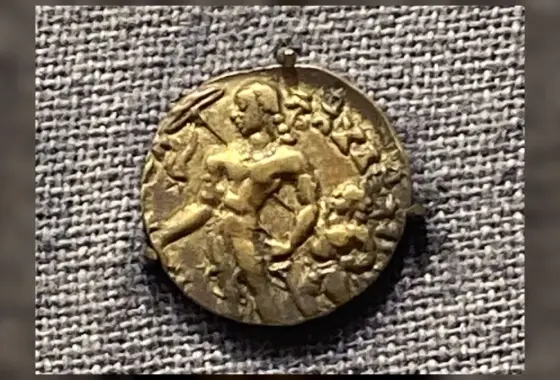
The Gupta dynasty rose around 320 when Chandragupta I gained power in the Ganges valley. His son Samudragupta conquered most of northern India in a series of campaigns and made the kingdoms of the south his tributaries.
Chandragupta II
Under Chandragupta II (Vikramaditya) the empire reached its height. The Chinese Buddhist pilgrim Faxian, who visited India in this period, wrote that the country was peaceful and prosperous. Hinduism grew stronger while Buddhism continued to flourish; the great Buddhist centre of learning at Nalanda was founded in the 5th century.
Science and literature
The mathematician and astronomer Aryabhata, in a work written in 499, proposed that the Earth rotates on its axis and gave a remarkably accurate value for pi. The place-value decimal system, including zero, developed in this period and later reached Europe through the Islamic world. The poet and playwright Kalidasa is one of the greatest figures of Sanskrit literature.
Art
Gupta sculpture, with its images of the Buddha and Hindu deities, set a model for later centuries. The rust-resistant Iron Pillar in Delhi is regarded as evidence of the metallurgical knowledge of the period.
End
In the late 5th century the Hephthalites (called Huna in Indian sources) from Central Asia attacked north-western India. These attacks and internal problems led to the break-up of the Gupta Empire in the mid-6th century and the rise of regional kingdoms.
Sources and further reading
- Encyclopaedia Britannica, “Gupta dynasty” and “Aryabhata”.
- UNESCO World Heritage, “Archaeological Site of Nalanda Mahavihara”.
- Faxian, A Record of Buddhistic Kingdoms.
People also ask
What was the Gupta Empire? The Gupta Empire was founded in northern India in the early 4th century and ruled for about two hundred years.
When was the Gupta Empire founded? Founded: c. 320, Chandragupta I.
What was the Gupta Empire’s capital? Capital: Pataliputra.
When did the Gupta Empire end? End: c. 550.
Leave a comment
Your email address will not be published. Required fields are marked *