



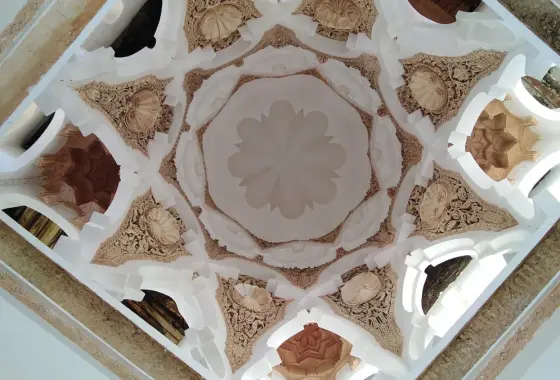
The Almoravids emerged from a religious movement launched by the scholar Abdallah ibn Yasin among the nomadic Sanhaja Berbers of the western Sahara. Their name is thought to come from “ribat”, a fortified lodge on the frontier for worship and jihad. The movement soon became a political and military power.
Yusuf ibn Tashfin and Marrakesh
Yusuf ibn Tashfin founded the city of Marrakesh in today’s Morocco around 1070 and made it his capital. He soon conquered Morocco and western Algeria. The Almoravids firmly supported the Maliki school of law and controlled the trans-Saharan gold trade; their gold dinars were known in Europe as “maravedís”.
Crossing into al-Andalus
After King Alfonso VI of Castile took Toledo in 1085, the small Muslim kingdoms of al-Andalus (the taifas) asked Yusuf for help. Yusuf defeated the Castilian army at Zallaqa (Sagrajas) in 1086. He then eliminated the quarrelling taifa kingdoms and united al-Andalus under Almoravid rule.
End
In the 12th century the Almohad movement, born in North Africa under Ibn Tumart, began a struggle against the Almoravids. The Almohads took Marrakesh in 1147, ending the Almoravid state.
Sources and further reading
- Türkiye Diyanet Vakfı İslâm Ansiklopedisi, “Murâbıtlar”.
- UNESCO World Heritage, “Medina of Marrakesh”.
- Encyclopaedia Britannica, “Almoravids”.
People also ask
What was the Almoravids? The Almoravids were a dynasty founded by a religious movement that arose among the Sanhaja Berbers of the western Sahara in the mid-11th century.
When was the Almoravids founded? Founded: c. 1040, movement of Abdallah ibn Yasin.
What was the Almoravids’s capital? Capital: Marrakesh (founded c. 1070).
When did the Almoravids end? End: 1147, Almohad capture of Marrakesh.




Leave a comment
Your email address will not be published. Required fields are marked *