



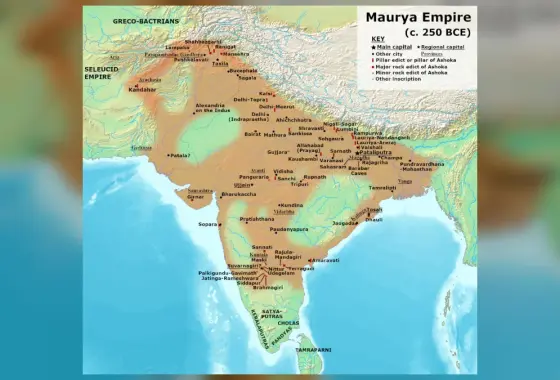
Soon after Alexander the Great withdrew from India, Chandragupta Maurya, with his adviser Kautilya (Chanakya), overthrew the Nanda dynasty of Magadha. The capital was Pataliputra on the Ganges. The Arthashastra, a treatise on government and politics, is attributed to Kautilya.
The treaty with Seleucus
Through a treaty with Seleucus I, founder of the Seleucid kingdom, Chandragupta acquired the Indus region and part of today’s Afghanistan, giving Seleucus hundreds of war elephants in return. Seleucus’s envoy Megasthenes wrote an account of the Maurya court.
Ashoka
Chandragupta’s grandson Ashoka conquered Kalinga on the east coast around 261 BC. According to his own edicts the great losses of this war deeply affected him; he embraced Buddhism and began to spread the principle of “dharma” (right living). The edicts he had carved on rocks and pillars are among the oldest documents of Indian writing. The four-lion capital from the pillar at Sarnath is used today as India’s state emblem. Missionaries sent by Ashoka helped spread Buddhism to Sri Lanka and other regions.
End
After Ashoka’s death the empire weakened and began to break up. In 185 BC the army commander Pushyamitra Shunga killed the last Maurya ruler and founded the Shunga dynasty.
Sources and further reading
- Encyclopaedia Britannica, “Mauryan empire” and “Ashoka”.
- UNESCO World Heritage, “Buddhist Monuments at Sanchi”.
- Romila Thapar, Aśoka and the Decline of the Mauryas.
People also ask
What was the Maurya Empire? The Maurya Empire was founded around 322 BC by Chandragupta Maurya and for the first time brought most of the Indian subcontinent under a single government.
When was the Maurya Empire founded? Founded: c. 322 BC, Chandragupta Maurya.
What was the Maurya Empire’s capital? Capital: Pataliputra (today’s Patna).
When did the Maurya Empire end? End: 185 BC, Pushyamitra Shunga.

Leave a comment
Your email address will not be published. Required fields are marked *