



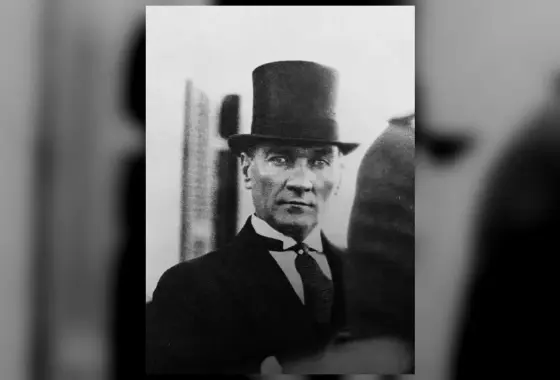
Mustafa Kemal was born in Thessaloniki in 1881, the son of Ali Rıza Efendi and Zübeyde Hanım. After military schools in Thessaloniki and Monastir he graduated from the War College in 1902 and from the Staff College in 1905 as a staff captain. He served in Tripolitania (1911) and the Balkan Wars.
Gallipoli
In 1915 he became known for his command at critical moments at Arıburnu and Anafartalar on the Gallipoli front; as commander of the Anafartalar Group he led the units that halted the Allied advance. In later years of the war he served on the Caucasus and Syrian fronts.
The War of Independence
When the country was occupied after the Armistice of Mudros, he landed at Samsun on 19 May 1919. Through the Amasya Circular and the Erzurum and Sivas congresses he organised national resistance. He was elected speaker of the Grand National Assembly of Türkiye when it opened in Ankara on 23 April 1920. After the Battle of Sakarya (1921) the Assembly gave him the title “Gazi” and the rank of marshal. The war was won with the Great Offensive that began on 26 August 1922 and the decisive battle of 30 August.
The republic and the reforms
He was elected first president when the republic was proclaimed on 29 October 1923. Under his leadership the caliphate was abolished (1924), the Turkish Civil Code adopted (1926), the new Turkish alphabet introduced (1928) and women given the right to vote and stand for office (1930, 1934). He pioneered the founding of the Turkish Historical Society (1931) and the Turkish Language Association (1932). His six-day speech to parliament in 1927, the Nutuk, tells the story of the War of Independence in his own words. In 1934, under the Surname Law, parliament gave him the surname “Atatürk”.
Death and legacy
Atatürk died at 9:05 a.m. on 10 November 1938 at Dolmabahçe Palace in Istanbul. His remains were moved in 1953 to Anıtkabir, his mausoleum in Ankara. Every year at 9:05 on 10 November people across Türkiye stand in silence to remember him. His motto “Peace at home, peace in the world” is remembered as a guiding principle of Turkish foreign policy.
Work on language, history and the university
Atatürk attached great importance to work in language and science so that the reforms would endure. The First Turkish Language Congress, organised by the Society for the Study of the Turkish Language, met at Dolmabahçe Palace on 26 September 1932; the date is still celebrated as Language Day. In 1933 the Darülfünun was closed and Istanbul University was founded in its place. The Geometry book Atatürk prepared in his final years helped establish the Turkish terms for angle, triangle, side and diameter that are used in schools today.
Building Anıtkabir
From 1938 to 1953 Atatürk's body lay in a temporary tomb at the Ankara Ethnography Museum. An international design competition for a permanent mausoleum was won in 1942 by the architects Emin Onat and Orhan Arda. Construction on Rasattepe began in 1944 and took about nine years, and on 10 November 1953 the body was moved to Anıtkabir in a state ceremony. The Road of Lions, the Ceremonial Plaza, the Hall of Honour and the Anıtkabir Atatürk and War of Independence Museum now welcome millions of visitors every year.
International commemoration: the year 1981
The centenary of Atatürk's birth was also marked internationally. By a resolution adopted in 1978, the UNESCO General Conference supported the celebration of the 100th anniversary in 1981; the resolution highlighted his contributions to peace, international understanding and education. That year exhibitions, academic meetings and publications commemorated him in Türkiye and in many other countries. The resolution shows that Atatürk is remembered not only in Türkiye but also by international institutions.
Sources and further reading
- Mustafa Kemal Atatürk, Nutuk (The Great Speech, 1927).
- Turkish Historical Society, publications on Atatürk and the War of Independence.
- Atatürk Research Center, “Life of Atatürk”.
- Encyclopaedia Britannica, “Kemal Atatürk”.
- Anıtkabir Command – "History of Anıtkabir"
- Turkish Language Association – "Founding and History of the Turkish Language Association"
- UNESCO General Conference, 20th session (1978) resolutions – centenary of the birth of Atatürk
People also ask
Who was Atatürk? Mustafa Kemal Atatürk (1881–1938) was the leader of the Turkish War of Independence and the founder and first president of the Republic of Türkiye.
When and where was Atatürk born? Atatürk was born in Thessaloniki in 1881, the son of Ali Rıza Efendi and Zübeyde Hanım.
What was Atatürk’s life like in brief? He graduated from the War College and Staff College, rose to prominence as commander of the Anafartalar Group at Gallipoli, began the War of Independence by landing at Samsun on 19 May 1919 and became the first president on 29 October 1923.
When did Atatürk die? Atatürk died at 9:05 a.m. on 10 November 1938 at Dolmabahçe Palace in Istanbul; his remains have rested at Anıtkabir in Ankara since 1953.
What were Atatürk’s reforms? The main ones were the abolition of the caliphate (1924), the Turkish Civil Code (1926), the alphabet reform (1928), women’s right to vote and stand for office (1930, 1934) and the Surname Law (1934).

Leave a comment
Your email address will not be published. Required fields are marked *