



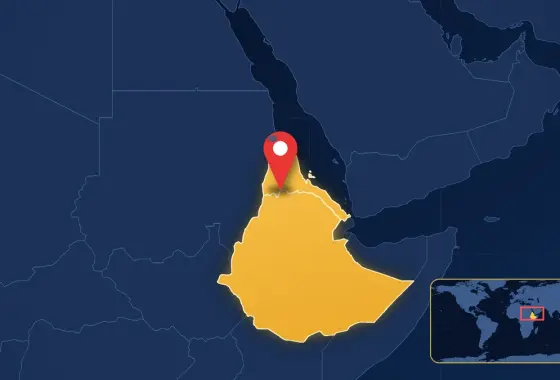
Tension between Ethiopia and Eritrea in the Horn of Africa has entered a new phase with reports that the two countries are massing troops along their shared border. According to a Reuters report published on 18 November and carried by Al-Monitor, the conflict monitor ACLED, the International Crisis Group and people close to armed groups in Tigray say the two armies have come within “striking distance” of each other. The developments have heightened fears of a repeat of the 1998–2000 border war, in which tens of thousands of people were killed.
According to ACLED, drones believed to be Ethiopian targeted likely Eritrean positions around the disputed border town of Badme on 12 November, and Eritrean forces responded with artillery fire towards Ethiopian positions. The organisation reported that troops of the two countries clashed on the Ethiopian side of the border the following day. These direct clashes, however, have not been independently confirmed: Reuters said it could not verify the claims, while a source close to the pro-government Tigray Peace Force maintained that Ethiopian troops were pursuing rebels towards the border without engaging Eritrean forces.
What are the two sides saying?
Eritrea’s Information Minister Yemane Gebremeskel described statements from Ethiopia’s ruling party about developments near the border as “propaganda”, but did not directly address the reports of military build-ups and clashes. Eritrea denies sending troops into Ethiopian territory. Ethiopia, for its part, accuses Eritrea of backing Tigrayan rebels. The Ethiopian government has not commented on the drone strikes that ACLED believes targeted Eritrean troops in October.
International Crisis Group analyst Magnus Taylor said the fighting near the border between Ethiopian forces and Tigrayan rebels was the biggest risk, warning that “this could also draw Eritrea further into the war on the side of the Tigrayans.” Ethiopia also accuses Sudan and Egypt of backing the rebels; both countries deny the claims.
What is the situation in Tigray?
Fighting has resumed between Ethiopia’s federal government and Tigrayan rebels since September 2026. According to Reuters, witnesses and the Ethiopian government said Eritrean forces entered Tigray in early October to support the rebels; Eritrea denies this. According to an assessment by the US-based Critical Threats project, Tigrayan forces have been resisting federal efforts to control the area around Tigray’s city belt since mid-October.
Badme’s symbolic importance stems from the 1998–2000 war. An independent boundary commission set up under the 2000 Algiers Agreement, which ended the war, awarded Badme to Eritrea in 2002; Ethiopia did not implement the decision for many years and only announced that it accepted it during the 2018 rapprochement. Because the town’s de facto status remains disputed today, any military movement in the area is seen as a sensitive matter between the two countries.
This picture shows how completely the alliances of a few years ago have been reversed. Ethiopia and Eritrea signed a peace agreement in 2018 and fought on the same side in the 2020–2022 Tigray war. After the agreement signed in Pretoria in November 2022, which ended the Tigray war, relations between the two countries steadily deteriorated.
Why does the dispute over Red Sea access matter?
One of the main drivers of the tension is landlocked Ethiopia’s demand for access to the Red Sea. With a population of more than 120 million, Ethiopia is the world’s most populous landlocked country and conducts most of its foreign trade through the port of Djibouti. Prime Minister Abiy Ahmed has repeatedly said that sea access is an existential issue for the country, while stating that the goal will be pursued through peaceful means. Eritrea, however, regards these calls as an implicit threat of aggression. According to Addis Standard, Eritrea’s port of Assab features prominently in the debate.
How has the international community responded?
In a joint statement issued after their meeting in Paris on 9–10 November, G7 foreign ministers said they noted with “great concern” the deteriorating security situation in the Horn of Africa, specifically between Ethiopia and Eritrea. According to Addis Standard, the statement stressed that cross-border tensions carry a risk of regional escalation and called on all parties to exercise maximum restraint, pursue diplomatic solutions, ensure safe and unhindered humanitarian access and protect civilians, especially women and children. It also reaffirmed the importance of respecting the sovereignty and territorial integrity of all countries in the region.
What does this mean?
The two armies facing each other on the border make the already fragile balance in the Horn of Africa even more dangerous. A possible direct war could deepen the humanitarian crisis in Tigray, turn the region, together with the civil war in Sudan, into a wide belt of instability and also affect maritime trade in the Red Sea. At this stage, the scale of any direct fighting is unclear and the two sides’ statements contradict each other; new reports from independent monitors and diplomatic mediation efforts will therefore be watched closely in the coming days.
This report was compiled as of 19 November 2026, 15:30 Türkiye time; follow developments as they are updated.
Frequently asked questions
Are Ethiopia and Eritrea going to war?
There is currently no declared war between the two countries, but conflict monitors report a troop build-up on the border and clashes around Badme. The direct clashes have not been independently confirmed.
Why is Badme important?
Badme is a disputed border town that was the flashpoint of the 1998–2000 Ethiopia–Eritrea war, which is why any movement there is closely watched.
What is driving the tension?
Renewed fighting in Tigray, accusations that Eritrea is backing the rebels and Ethiopia’s demand for access to the Red Sea are the main drivers of the tension.
Sources and further reading
- Al-Monitor (Reuters), “Ethiopia and Eritrea amass forces along border, heightening war fears, sources say”, 18 November 2026.
- Addis Standard, “G7 warns of regional escalation risk as Ethiopia-Eritrea tensions worsen”, November 2026.
- Critical Threats, “Ethiopia War Security Review, November 13, 2026”, 13 November 2026.



Leave a comment
Your email address will not be published. Required fields are marked *