




When the car in front brakes suddenly, you need two things to stop: the time it takes to notice the danger and press the brake, and the distance your car needs to actually come to a halt. A safe following distance leaves enough space for both.
Stopping distance has two parts
- Thinking distance: How far you travel between seeing the danger and moving your foot to the brake. For an average driver this takes about one second, and it grows noticeably with fatigue, distraction or phone use.
- Braking distance: How far the car travels after you press the brake until it stops. It grows with the square of your speed, so doubling your speed roughly quadruples your braking distance.
How to use the two-second rule
- Watch the moment the vehicle ahead passes a fixed point by the road (a post, sign or bridge).
- Count to yourself: "one thousand and one, one thousand and two".
- If you reach the same point before you finish counting, you are too close; slow down.
The rule automatically gives a suitable gap at any speed, because the distance covered in two seconds grows as speed increases.
When to increase the gap
- On wet roads: at least 4 seconds,
- on snow and ice: much more (up to 8–10 seconds),
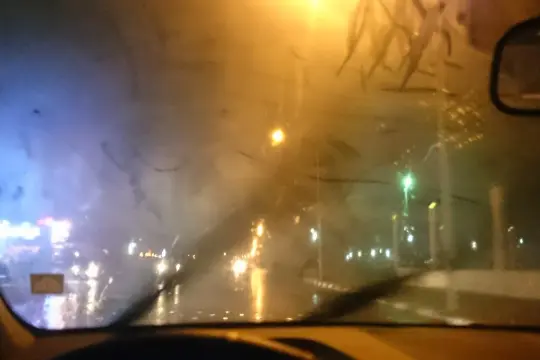
- at night and in fog,
- behind heavy vehicles (your view is restricted),
- when tired or when your car is heavily loaded.
If the driver behind is too close
If the driver behind isn't keeping their distance, open up a little more space in front of you. That reduces the chance you'll have to brake hard and lowers the risk of being hit from behind. If possible, change lanes and let them pass.
Typical stopping distances by speed
The Highway Code, the official guide to traffic rules in the United Kingdom, gives the following typical stopping distances (thinking distance + braking distance) for a car in good condition on a dry road with an alert driver:
- About 32 km/h (20 mph): 12 metres
- About 48 km/h (30 mph): 23 metres
- About 80 km/h (50 mph): 53 metres
- About 113 km/h (70 mph): 96 metres
The figures clearly show that when speed doubles, stopping distance increases by much more than double. According to the same guide, these distances can at least double on a wet road and increase up to tenfold on ice. That is why in bad weather the 2-second rule should be extended to at least 4 seconds.
Driver assistance systems are no substitute for distance
Systems in newer cars such as automatic emergency braking (AEB) and adaptive cruise control help reduce the risk of collisions, and independent testing bodies assess them in vehicle safety ratings. But these systems only see as much as their sensors can; they may fall short in heavy rain, snow, with a dirty camera or in unexpected situations. Leaving enough following distance remains an alert driver's first line of defence, far more reliable than these technologies.
Heavy vehicles, buses and motorcycles also need special attention when it comes to following distance. Lorries have longer braking distances and wide blind spots; if you follow too closely, the driver may not be able to see you. Because motorcycles can manoeuvre suddenly, increasing the distance behind them is also safer for both sides.
Frequently asked questions
Does ABS shorten braking distance?
ABS mainly prevents the wheels locking under hard braking so you can still steer. It may shorten braking distance on some surfaces, but it is no substitute for a proper following distance.
Are automatic emergency braking systems enough?
They are an important safety layer, but they may not activate in every situation. The driver's attention and the right distance are always the first line of defence.
Sources and further reading
- The Highway Code (UK) – Typical stopping distances and rule 126
- Euro NCAP – Autonomous Emergency Braking (AEB) test protocols
- NHTSA (US) – Driver assistance technologies



Leave a comment
Your email address will not be published. Required fields are marked *