



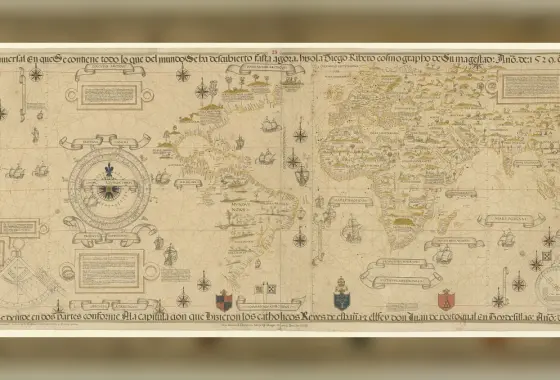
The marriage in 1469 of Ferdinand, heir of Aragon, and Isabella, heir of Castile, brought the two kingdoms under the same rulers once Ferdinand took the throne of Aragon in 1479. In 1492 the “Catholic Monarchs” took Granada, the last Muslim state in al-Andalus. The same year Jews were expelled, and in the following years Muslims were also persecuted.
The New World
In 1492 Christopher Columbus, backed by Isabella, reached the Americas. Hernán Cortés then destroyed the Aztec Empire and Francisco Pizarro the Inca Empire. Silver from the Americas made Spain one of the richest states in Europe, but the conquests caused great losses among the indigenous peoples.
The Habsburgs and the peak
Charles I, who came to the throne in 1516, was elected Holy Roman Emperor Charles V in 1519, gathering a vast inheritance in one hand. Under his son Philip II, Spain ruled an empire from the Philippines to the Americas; in 1571 it fought the Ottomans at Lepanto with the fleet of the Holy League. The failure of the “Invincible Armada” sent against England in 1588 was a turning point. Cervantes’s Don Quixote and the paintings of Velázquez are symbols of the “Golden Age”.
Decline
When the Habsburg line died out in 1700, the War of the Spanish Succession broke out and the Bourbon dynasty took the throne. In the early 19th century the countries of Latin America won independence. In the Spanish–American War of 1898 Cuba, Puerto Rico and the Philippines were also lost — regarded as the end of the imperial era.
Sources and further reading
- Encyclopaedia Britannica, “Spain: History”.
- J. H. Elliott, Imperial Spain 1469–1716, Penguin.
- Henry Kamen, Spain’s Road to Empire, Penguin.
People also ask
What was the Spanish Empire? The Kingdom of Spain was born when Castile and Aragon were united under the Catholic Monarchs Ferdinand and Isabella.
When did the Spanish Empire end? End: Spanish–American War, 1898.

Leave a comment
Your email address will not be published. Required fields are marked *