



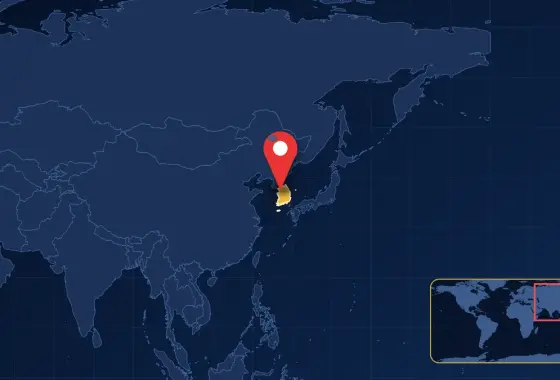
South Korea’s annual exports passed the $1 trillion threshold for the first time at about 2:09 p.m. local time on Thursday, 19 November 2026. According to The Korea Times and The Korea Herald, the figures released by the Ministry of Trade, Industry and Resources make South Korea the fourth country to reach this level after the United States, Germany and China; The Korea Herald described it as the first new entrant to the club in 19 years. The government expects total 2026 exports to be about $1.17 trillion, roughly 65% above the 2025 record of $709.3 billion.
President Lee Jae-myung wrote on X that the gains from exports must, above all, improve people’s lives. Industry Minister Kim Jung-kwan said: “We will not rest on this year’s $1 trillion export milestone.”
What do the numbers say?
In January–October exports reached $930.2 billion. Of that, $396.8 billion came from semiconductors, which is about 43% of the total and almost triple the $135.4 billion in the same period of 2025. According to The Korea Times, exports excluding chips also rose 20%. Sixteen of the 20 major product categories grew, and exports rose to seven of nine major markets. According to figures carried by Anadolu Agency, chip shipments to China rose 234% to $124.3 billion and those to the US rose 450% to $55.4 billion.
There are notable items beyond semiconductors too: the export price of petroleum products rose 62% to $1,105 per tonne. Cosmetics exports reached $12.4 billion in ten months, already surpassing the previous full-year record of $11.4 billion. This variety shows that the growth does not depend on a single sector alone; still, it is also clear that about 43% of the share comes from semiconductors.
Imports and the trade surplus
According to The Korea Herald, imports in the same period rose 21% to $635.1 billion, leaving a trade surplus of about $295 billion through October; for the whole of 2025 the figure was $77.4 billion. Kang Gam-chan, the ministry’s director general for trade and investment, added a caution: he said part of the $1 trillion belongs to imports and that Korea should not be a country that simply sells goods. According to The Korea Times, Kang also noted that the benefits are “less noticeable to the general public”; in other words, the figures do not reach every citizen’s pocket to the same degree.
AI investment and chip demand
Behind the jump in semiconductors is demand generated by global artificial intelligence investment. The ministry said earlier that semiconductor exports in June rose 199.5% to $44.8 billion and linked this to AI infrastructure spending. South Korea’s weight in memory chips has let it benefit directly from this demand boom. However, the industry minister listed the spread of global protectionism and tensions in the Middle East as sources of uncertainty for outbound shipments.
A “new growth engine” message on Friday
According to Yonhap, on 20 November Kim Jung-kwan met six trade associations, including the Federation of Korean Industries and the Korea Chamber of Commerce and Industry. “I am worried about what will emerge as the next major growth industry after semiconductors,” the minister said. The government was reported to be set to support regional investment, overseas expansion by small and medium-sized enterprises, and robotics, biotechnology and aerospace.
Historical context
South Korea reached today’s threshold through decades of an export-led industrialisation model. That exports, which set a record of $709.3 billion in 2025, are approaching a trillion within a year shows how much growth has accelerated. Much of that acceleration stems from price and volume increases in a single product category, semiconductors.
What does this mean?
For South Korea, $1 trillion is both a prestige threshold and an indicator of how tied the economy is to the global chip cycle. If semiconductor demand slows, exports, the trade surplus and growth expectations could be affected quickly; the government’s search for the “next growth engine” is therefore more than a slogan, signalling awareness of the risk. On the other hand, increases in items such as cosmetics and petroleum products reported by The Korea Times suggest the export basket is relatively broadening. The figures are based on preliminary data and may differ from the finalised year-end results.
This report was compiled as of 20 November 2026, 19:00 Türkiye time; casualty and damage figures may differ between sources and should be followed as developments are updated.
This article is for general information only and is not investment advice. Review the official data before making any investment decision and consult a licensed adviser if needed.
Frequently asked questions
When did South Korea’s exports pass $1 trillion?
Cumulative exports passed the $1 trillion threshold at about 2:09 p.m. local time on Thursday, 19 November 2026.
Which other countries have passed the threshold?
The US, Germany and China. South Korea joined the group as the fourth country.
What is the year-end projection for 2026?
The government projects year-end exports of about $1.17 trillion, roughly 65% more than the $709.3 billion of 2025.
What is the main source of the increase?
Semiconductors: at $396.8 billion in January–October they made up about 43% of the total and rose to about triple the same period a year earlier.
Sources and further reading
- The Korea Times, “Korea becomes world’s 4th country to reach $1 tril. in annual exports”, 19 November 2026.
- The Korea Herald, “South Korea’s exports top $1 trillion for first time on chip boom”, 19 November 2026.
- The Korea Times (Yonhap), “Industry minister calls for new growth engine to go beyond $1 tril. in exports”, 20 November 2026.
- Anadolu Agency, “Morning Briefing: Nov. 20, 2026”, 20 November 2026.


Leave a comment
Your email address will not be published. Required fields are marked *