



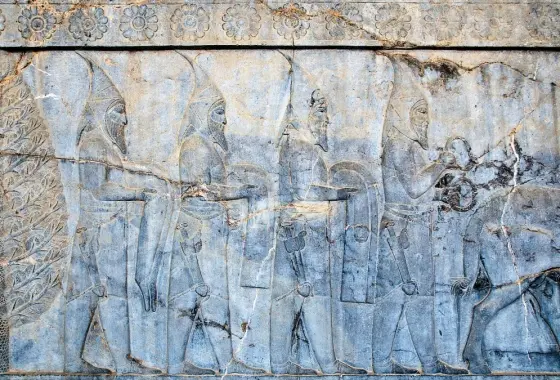
The Scythians emerged as a powerful people on the steppes north of the Black Sea in the 8th and 7th centuries BC. Masters of mounted archery, they followed the Cimmerians and raided through the Caucasus into Anatolia and the Near East. Related peoples living to the east, in Kazakhstan and Central Asia, are called Saka in Persian sources.
Herodotus and Darius
The Greek historian Herodotus describes the customs, sacrificial rites and kings of the Scythians in detail in the fourth book of his work. Around 513 BC the Persian king Darius I crossed the Bosphorus and the Danube to campaign against them; the Scythians avoided pitched battle and wore down the Persian army by withdrawing.
Kurgans and art
Scythian and Saka chiefs were buried with horses, weapons and gold objects in tombs beneath great earthen mounds (kurgans). The animal style, with figures of deer, horses and predators, is the hallmark of steppe art. The find from the Issyk kurgan in Kazakhstan, called the “Golden Man” for his costume covered with gold plaques, is one of the most famous works of Saka culture.
Origins and Turkish historiography
International research mostly regards the Scythians and Saka as Iranian-speaking peoples. Turkish historiography, however, emphasises the Saka’s links with Turkic history, pointing to shared features of steppe culture and to the tradition of Alp Er Tunga in Turkic epics and Afrasiyab in Iranian sources. Tomyris, queen of the Massagetae, is also an important figure of this steppe world.
End
From the 3rd century BC the Sarmatians, coming from the east, pushed the Scythians into Crimea and the lower Dnieper. The Scythian kingdom in Crimea survived until the 3rd century AD.
Sources and further reading
- Herodotus, Histories, book IV.
- Bahaeddin Ögel, Türk Kültür Tarihine Giriş.
- Encyclopaedia Britannica, “Scythian”.
People also ask
What was the Scythians and Saka? The Scythians were horse-riding nomadic peoples of the 1st millennium BC who lived on the steppes stretching from north of the Black Sea to Central Asia.


Leave a comment
Your email address will not be published. Required fields are marked *