



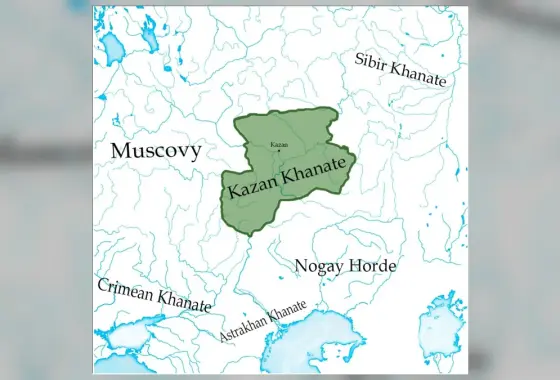
The Khanate of Kazan was founded when Ulugh Muhammad, a former khan of the Golden Horde, settled on the middle Volga in the late 1430s. The region was the old homeland of the Volga Bulgars, who had adopted Islam in the 10th century; the khanate’s people combined this heritage with Kipchak Turkic.
Trade and culture
Kazan was one of the main centres of the Volga trade in furs, hides and grain. Mosques, madrasas and markets flourished in the city, and Turkic literature and religious education spread. The khanate maintained relations with the Crimean Khanate, the Nogais and the Ottomans.
Struggle with Moscow
From the late 15th century the growing Grand Principality of Moscow often intervened in Kazan’s affairs, at times placing its own candidates on the throne. The khanate was torn by a constant struggle between pro-Moscow and pro-Crimean/Ottoman factions. Söyembikä, a khan’s wife and regent, is one of the symbolic figures of this period.
The fall of Kazan
Tsar Ivan IV besieged Kazan with a large army in 1552; after gunpowder was detonated in mines dug under the walls, the city fell on 2 October 1552. St Basil’s Cathedral in Moscow was built to commemorate the victory. The capture of Kazan opened the way for Russia’s expansion along the Volga to the Caspian and into Siberia. The Kazan Kremlin is now on the UNESCO World Heritage List.
Foundation: The Breakup of the Golden Horde and Ulugh Muhammad
The Khanate of Kazan emerged as the Golden Horde fragmented through succession struggles and civil wars in the first half of the 15th century. Khan Ulugh Muhammad, defeated in the power struggle at Sarai, withdrew north and gathered strength in the middle Volga, in the settled lands left by the Volga Bulghars. The founding date varies between 1437 and 1445 depending on the source, because the formation of a state was a process of several years rather than a single day.
After Ulugh Muhammad his son Mahmud consolidated the khanate and made Kazan a lasting capital. The first clashes with the Grand Principality of Moscow also began in this period. The khanate became part of a new political balance in the region together with the Crimean, Astrakhan, Siberian and Kasimov khanates that arose from the Golden Horde’s breakup.
Government and Society: the Khan, the Karachi Beys and the Peoples
In the government of the khanate the khan, the noble families and the divan all played a part. The great tribal and clan leaders known as karachi beys had a strong voice in the choice of the khan and in affairs of state, so khans could not act as absolute rulers. The nobles’ habit of leaning on different foreign powers kept the question of who would take the throne permanently open.
Most of the population were Kazan Tatars, but the khanate’s lands were also home to Chuvash, Mari (Cheremis), Udmurts, Bashkirs and Mordvins. These peoples mostly paid the tax called yasak, contributing furs, honey and wax to the khanate’s revenue. Part of the population had embraced Islam while others kept their older beliefs; this diversity enriched the khanate as much as it complicated its government.
Economy, Raids and the Russian Frontier
Kazan’s economy rested on farming, herding, forestry and Volga trade. The city lay where caravan and river routes between Central Asia and the Russian lands crossed, and merchants from different regions bought and sold goods at the annual fairs. The khanate’s monetary and tax income depended on this lively commerce.
At the same time, raids by Kazan forces on Russian border districts were among the main causes of tension between the two sides. The taking of captives in these raids and their sale elsewhere pushed Moscow to strengthen its frontier defence and to adopt a hard policy toward Kazan. Cutting off trade, that is, Moscow’s occasional bans on Kazan merchants entering its markets, was also used as a weapon that squeezed the khanate economically.
Syuyumbike, the Regency and the Struggles for the Throne
In the first half of the 16th century the Kazan throne changed hands often. Candidates such as Safa Giray, of the Crimean Girays, and Shah Ali, backed by Moscow, repeatedly replaced one another. This instability came from noble factions divided between a Crimean–Ottoman orientation and a Muscovite one.
Syuyumbike, the daughter of a Nogai khan, is the best-known female figure of the period. After the death of her husband Safa Giray in 1549 she ruled as regent in the name of her young son Utemish Giray. In 1551, under pressure from Moscow, she was removed from power and taken to Moscow with her son. The stories that live among the people of Kazan and the legend of the Syuyumbike Tower in the city show that she is still a powerful symbol; the claim that the tower belonged to her is not historically proven.
After Kazan: Legacy and the Kazan Kremlin
After 1552 the khanate’s lands were annexed to the Tsardom of Russia, and resistance and uprisings in the region continued for years. The Kazan Tatars and the region’s other peoples met different pressures at different times under Russian rule; even so, they preserved their language, religion and identity and formed the basis of today’s Tatar culture. Kazan University, founded in 1804, made the region an important centre of science and culture in Russia.
Today Kazan is the capital of the Republic of Tatarstan. The Kazan Kremlin was inscribed on the UNESCO World Heritage List in 2000. The Kul Sharif Mosque inside the Kremlin bears the name of the cleric who is said to have led the defence in the 1552 siege and to have died in the fighting; the mosque was rebuilt and opened in 2005. In this way the memory of the khanate lives on in the city’s skyline.
Historical Context for Understanding the Kazan Khanate
The story of the Kazan Khanate is the story not of one state alone but of an age in which the balance of power in Eastern Europe was changing. The weakening of Mongol dominance, Moscow’s gathering of the surrounding Russian lands and the emergence of new centres of power along the Volga are parts of the same process. In this process Kazan existed both as a centre of trade and culture and as a border state between two worlds.
Historians note that Russian and Tatar sources place different emphasis on this period. Russian chronicles mostly present the khanate as a threat, while Tatar accounts present it as the loss of independence. For a balanced assessment, many sources need to be read together and one-sided judgements avoided.
Sources and further reading
- Türkiye Diyanet Vakfı İslâm Ansiklopedisi, “Kazan Hanlığı”.
- UNESCO World Heritage, “Historic and Architectural Complex of the Kazan Kremlin”.
- Encyclopaedia Britannica, “Kazan, khanate of”.
- Türkiye Diyanet Foundation Encyclopaedia of Islam, entry “Kazan Hanlığı”.
- UNESCO World Heritage Centre, “Historic and Architectural Complex of the Kazan Kremlin” (2000).
- Encyclopaedia Britannica, entries “Kazan” and “Golden Horde”.
People also ask
What was the Khanate of Kazan? The Khanate of Kazan was founded on the Volga around 1438 by Ulugh Muhammad Khan, during the break-up of the Golden Horde.
When was the Khanate of Kazan founded? Founded: c. 1438, Ulugh Muhammad Khan.
What was the Khanate of Kazan’s capital? Capital: Kazan.
When did the Khanate of Kazan end? End: 2 October 1552, siege by Ivan IV.
Leave a comment
Your email address will not be published. Required fields are marked *